
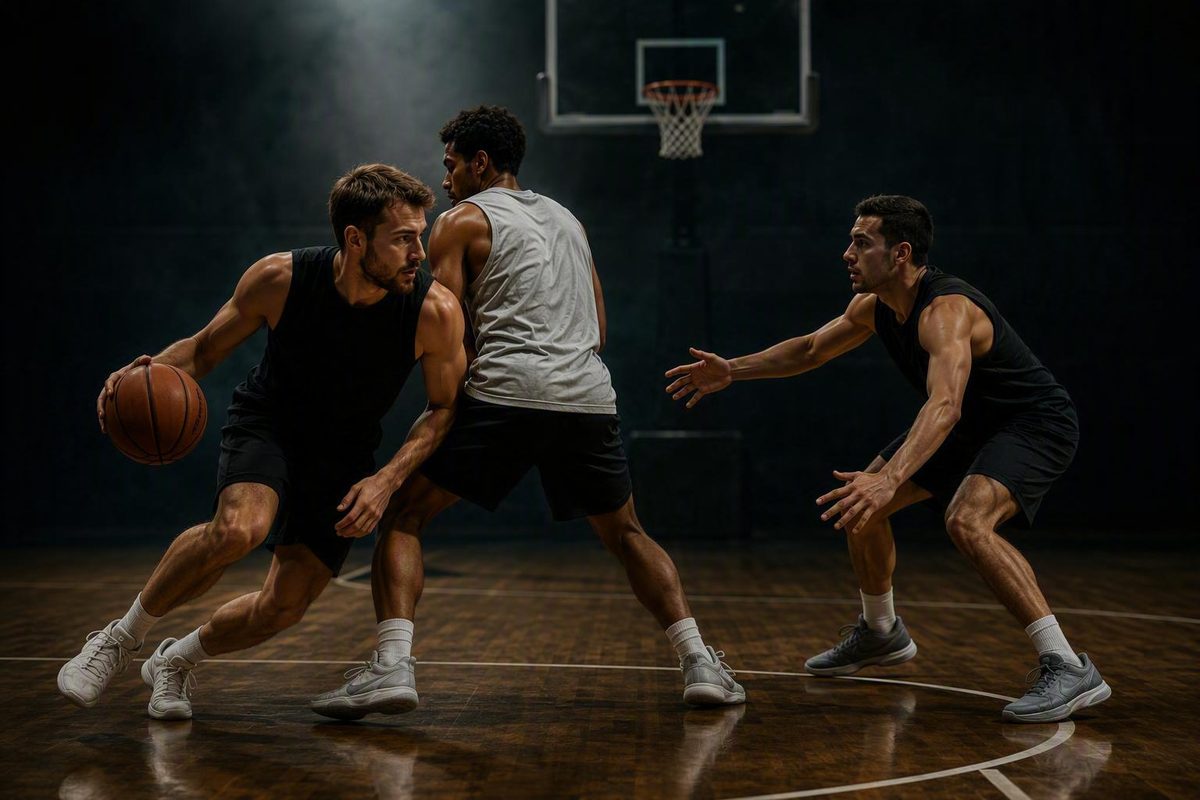
A basketball screen and roll is not a preset exchange in which the ball handler must pass to the screener. It is a coordinated decision sequence.
The screener arrives, establishes a stable position, and creates a useful angle. The ball handler waits, uses the screen closely, and reads both defenders. The screener then rolls, slips, or pops according to the defense, available space, and personal skill set. Meanwhile, the other three offensive players preserve passing lanes and occupy help defenders.
The action succeeds when those decisions connect. A solid screen means little if the ball handler leaves too early. A tight turn creates no advantage if the roller cannot see the pass. A clean two-player read can still fail if teammates crowd the lane.
The goal, therefore, is not to memorize one “correct” outcome. It is to learn a repeatable process that produces the right choice for the situation.
What the Screen and Roll Is
A screen and roll is a two-player offensive action:
- A player without the ball screens the defender guarding the ball handler.
- The ball handler uses the screen while reading both involved defenders.
- The screener moves toward the basket after the screen.
Screen and roll, pick-and-roll, on-ball screen, and ball screen commonly refer to this same basic action. Terminology may vary by coach or program, but the central sequence remains a screen for the player with the ball followed by a roll toward the basket. These common names and the basic sequence appear in the Basketball for Coaches offensive guide.
Consider a simple wing setup. The ball handler starts outside the three-point line. A teammate comes from the top of the floor or the interior and screens the on-ball defender. Once the screener is established, the ball handler attacks off the screen. The screener then opens toward the ball and moves toward the rim.
That movement can create several possible outcomes:
- The ball handler turns the corner and drives.
- The ball handler takes a balanced pull-up.
- The ball handler passes to the roller.
- Help defense commits, leaving another teammate open.
- The defense contains the initial action, and the offense keeps possession.
None of these outcomes is guaranteed. The screen does not automatically create an open shot, and the roller is not automatically the correct receiver.
The action is best understood as a read because several variables change from possession to possession:
- Screen angle: A screen angled toward the middle creates a different route from one angled toward the baseline.
- Court location: A high screen provides space on both sides, while a side or corner screen brings the sideline or baseline into the defense.
- Coverage: Drop, switch, hedge, blitz, under, and ice coverages concede different areas.
- Spacing: Crowded gaps make driving and rolling lanes disappear.
- Personnel: A strong pull-up shooter, downhill driver, interior finisher, and perimeter-shooting screener will not make identical choices.
- Help position: A pass that appears open against two defenders may be covered by a third defender rotating from the weak side.
Think of the screen as a way to make the defense declare itself. Once the defenders react, the offense must recognize what they protected, what they conceded, and whether the apparent opening is usable.
Before the Screen: Angle, Timing, and Setup
The action begins before the screener reaches the defender. Both offensive players must organize the angle, timing, and space required to make the screen meaningful.
Start with a basic wing setup
Place the ball handler on a wing, outside the three-point line. The screener can arrive from the top, the lane, or the opposite interior area. The exact starting spots are less important than giving the screener a clear approach and the ball handler enough room to move the defender.
Screens can be initiated from several locations:
- High screen: Near the top of the floor.
- Wing or side screen: Along either side above the corner.
- Corner screen: Close to the corner, where the boundary limits escape routes.
- Flat screen: The screener’s back generally faces the basket, allowing the handler to choose either side.
- Elbow screen: Set near an elbow or just outside that area.
Each location changes the driving angle, likely help positions, and the defense’s ability to trap or contain the ball. These labels describe starting geometry, not complete plays.
The ball handler’s setup
The ball handler should not stand still and wait for the screen to collide with the defender. Instead, create enough separation to guide the defender into the screen’s path.
Useful setup methods include:
- A controlled dribble away from the intended route.
- A hesitation or change of pace.
- An opposite-direction fake.
- A brief retreat that creates room to attack forward.
- A change of hand that shifts the defender’s hips.
The handler must still wait until the screen is established. Leaving too early allows the on-ball defender to slide through before the screen matters and may encourage the screener to move while trying to catch up.
Throughout the setup, stay balanced and keep the head up. The handler needs to see the screener arriving, the on-ball defender’s position, the screener defender’s depth, and any help defender leaning into the action.
The screener’s setup
The screener should communicate the screen’s direction, arrive under control, and choose an angle based on the desired route. The target is the defender’s path—not a defender who keeps moving away.
Approaching at roughly a 45-degree angle and screening near the on-ball defender’s back hip can be useful teaching references. USA Basketball also presents brushing the screener’s shoulder at approximately that angle as a practical cue. It is not a universal geometric requirement for every screen location or coverage (USA Basketball’s pick-and-roll drill).
Ask two questions before setting the screen:
- Where do we want the ball handler to go?
- Where is the on-ball defender trying to recover?
The answers determine the screening line. A screener who arrives without understanding the intended route may direct the ball into help or set an angle the defender can easily avoid.
The other three players matter
The uninvolved players should stay out of the immediate ball-screen lane while remaining available as outlets. Their spacing should force help defenders to decide whether to stop the ball, tag the roller, or stay attached to an off-ball player.
There is no universal five-player alignment for every team. Appropriate positions depend on the screen location, shooting ability, offensive system, and expected help. The durable principle is this: do not allow one defender to guard the ball handler, roller, and an off-ball teammate from the same crowded area.
How to Set and Use the Screen
Execution depends on two connected skills: the screener must establish a usable position, and the ball handler must wait long enough to use it.
Screener checklist
As the screen is established:
- Use a wide, stable base.
- Bend the knees enough to maintain balance through ordinary contact.
- Square the body to the intended screening line.
- Establish the position before contact.
- Remain stationary as the defender encounters the screen.
- Keep the arms and elbows under control.
- Do not lean, reach, or extend an elbow, hip, or knee to catch the defender.
These are general screening fundamentals, not a complete ruling standard. Exact legality depends on the governing rules and the circumstances of the play. Players and coaches should consult the current rulebook for their competition rather than assume that every league applies identical standards. General coaching guidance likewise emphasizes stationary positioning, spacing, and timing as central screening considerations (Basketball Coach Weekly’s guide to screens).
The screener should not chase the defender across the court. Arrive at the correct spot, establish the stance, and let the ball handler bring the defender into the screen.
Ball-handler checklist
As the screen arrives:
- Wait until the screener is established.
- Shift the defender with a fake or change of pace.
- Attack close to the screener.
- Keep the dribble protected and under control.
- Look at both involved defenders rather than watching the floor.
- Maintain awareness of the roller and weak-side help.
- Be prepared to stop, pass, retreat, or continue the dribble.
“Shoulder-to-shoulder” is a useful cue. It tells the handler to pass close enough to the screener that the defender cannot recover through a large gap. It does not mean the handler should collide with the screener, lose balance, or stare down at a prescribed spot.
The ideal path is as tight as the handler can take while preserving control and vision.
The screener’s roll
After the handler clears the screen, the screener should:
- Open toward the ball.
- Keep visual contact with the passer.
- Present a hand as a passing target.
- Move decisively toward the basket.
- Prepare to catch in traffic and finish or make the next pass.
There are at least two workable ways to begin the roll. One is a reverse pivot that opens the screener’s chest toward the ball. Another is a direct dive into the open lane. The better choice depends on body position, screen angle, defender location, and pass timing. Neither method is universally superior.
The key is orientation. A screener who turns without seeing the ball may run past the passing window. A screener who opens but does not move decisively gives the defense time to recover.
The Ball Handler’s Decision Tree
The ball handler should read the action in layers rather than deciding on a pass or shot before the screen arrives.
First read: the on-ball defender
Start with the defender who began on the ball:
- Did the defender trail over the screen?
- Did the defender go underneath?
- Did the defender jump toward the expected route?
- Did the defender recover in front?
- Is the defender attached to the handler’s hip or completely behind the play?
If the defender trails, the handler may have a route toward the lane or space for a pull-up. That is only the first read, however. The screener’s defender may already be waiting in the driving path.
Second read: the screener’s defender
Next, identify the second defender’s position:
- Stays back: The defender protects the basket while allowing some space in front.
- Switches: The defender takes the ball handler while the original on-ball defender takes the screener.
- Shows or hedges: The defender steps into the handler’s path temporarily and then tries to recover.
- Blitzes: Both defenders stay committed to the ball longer and try to force a retreat, turnover, or difficult release pass.
Once the handler recognizes those positions, the primary choices become clearer.
Turn the corner
Drive when there is a controlled path past the screen and the next defender cannot stop the ball without conceding another useful option. Do not confuse getting around the original defender with having an open lane. A low help defender may already be waiting.
Attack with enough pace to force a decision, but not so quickly that the dribble outruns the ability to pass.
Take the pull-up
A balanced pull-up can punish a defender who stays too deep or goes under, provided it is an appropriate shot for that player. The handler should arrive on balance rather than drifting sideways or shooting merely because the coverage has a familiar label.
Pass to the roller
Deliver the pass when the roller has separation and help cannot immediately intercept or contest it. A bounce pass may fit beneath reaching arms, but it is only one possible delivery. The correct pass depends on the defenders’ hands, the distance, the roller’s position, and the available angle.
Do not force the pass because the play is called “screen and roll.” Sometimes the roller’s movement primarily pulls help away from another teammate.
Find the weak side
When a help defender leaves an off-ball player to stop the drive or tag the roller, the next pass may go to the perimeter rather than inside. Keep the head and shoulders organized enough to see that rotation.
The best read may also be a simple pass out followed by another action. Preserving an advantage is better than forcing the first available window.
Reject the screen
A rejection means attacking away from the screen. Use it when the on-ball defender anticipates the action, jumps over the intended path, or turns too far toward the screener—and when the opposite lane is available.
A rejection should come from a defensive read, not impatience. If the weak side is crowded or the screener arrives in the alternate path, rejecting may create no advantage.
Split, attack the hip, or retreat
Against pressure, the handler may have three situational counters:
- Split: Dribble between the defenders only if a genuine gap exists and the ball can be protected.
- Attack the hedge defender’s hip: Turn the corner tightly before the defender can square the body.
- Retreat: Back out while preserving the dribble when both defenders close the path.
Retreating is not surrender. It can create a safer passing angle, stretch the trap, or allow the offense to continue without a reckless turnover.
Defender depth, help rotations, spacing, passing ability, finishing ability, and shooting range determine which option is viable. No response works automatically against every defense.
The Screener’s Choices: Roll, Slip, or Pop
The screener also has a decision tree. The three core options are the roll, slip, and pop.
Roll
A traditional roll occurs after the screener establishes the screen and moves toward the basket.
Use these cues:
- Open toward the ball.
- Show a clear target.
- Stay visually connected to the handler.
- Move decisively into available space.
- Be ready to catch, finish, or pass if help rotates.
A roll is attractive when the screener defender steps toward the ball, the lane is available, or a switch leaves a smaller defender on the screener. A roll into multiple help defenders, however, is not automatically productive.
Slip
A slip occurs when the screener cuts before fully setting the screen. It is most useful when defenders anticipate the action, cheat high, prepare to switch early, or leave the screener’s path to meet the ball.
The slip attacks anticipation. The defense prepares to deal with contact that never arrives, and the screener leaves first.
Slipping without a defensive reason can erase the screen’s value. If the screener departs while both defenders remain in sound position, the ball handler receives neither a useful screen nor a clear passing lane.
Pop
A pop sends the screener into open perimeter or high-post space instead of toward the basket. It is most credible when the screener can shoot or attack effectively from the catch. Otherwise, moving outside may not force the defense to follow.
In a pick-and-pop, the ball handler should attack far enough to engage the screener’s defender. If the pass goes back before that defender commits, the defense may recover without conceding anything.
The popping screener should relocate promptly and prepare to receive with:
- Shoulders organized toward the basket.
- Feet ready to stop on balance.
- Hands visible.
- Eyes reading the closeout.
A detailed pick-and-pop progression similarly emphasizes engaging the screener’s defender and preparing the shoulders, feet, and hands for the catch (Basketball for Coaches’ pick-and-pop explanation).
The choice remains conditional:
- Roll when the route to the basket or an interior seal is useful.
- Slip when the defense leaves early to anticipate or switch.
- Pop when outside space is available and the screener can threaten from there.
Defensive position, team spacing, matchups, and the screener’s skills matter more than the name of the play.
How to Read Common Defensive Coverages
Coverage labels provide a shared language, but they do not describe every weak-side rotation or guarantee one correct counter. Use the following matrix as a starting point.
| Coverage | Defender positioning | Likely concession | Ball-handler options | Screener response |
|---|---|---|---|---|
| Drop | Screener defender retreats toward the basket; on-ball defender recovers from behind | Space in front of the drop, depending on depth | Controlled pull-up, drive into the gap, pass to the roller, or move the ball when help commits | Roll behind or beside the drop; pop if skill and spacing support it |
| Switch | Defenders exchange assignments | Potential size or speed matchup | Attack a favorable perimeter matchup, pass inside, or move the ball before help loads up | Roll or slip quickly; seal a smaller defender |
| Hedge/show | Screener defender steps temporarily into the dribbler’s path, then recovers | Space behind the hedge during recovery | Split an open gap, attack the defender’s hip, retreat, or pass as the defense recovers | Roll into the space created by the recovery |
| Blitz/trap | Both defenders remain committed to the ball longer | An outlet may be open away from the two defenders | Protect the ball, create retreat space, and find the release pass | Get available beyond the pressure or create a clear passing window |
| Going under | On-ball defender travels beneath the screen | Perimeter space | Shoot if suitable; otherwise continue, re-attack, or move the ball | Hold the screen long enough to affect the route, then roll or pop |
| Ice | Side-screen defense denies the middle and directs the ball toward the sideline or baseline | A restricted outside channel or altered screen angle | Reject if the lane exists, attack the permitted channel, or reset | Adjust the angle or become available according to team spacing |
These basic structures—particularly the distinction between a temporary hedge and a longer two-defender blitz—are summarized in a guide to drop, switch, hedge, blitz, and ice coverages.
Drop
In drop coverage, the screener’s defender retreats toward the basket while the on-ball defender works around the screen and recovers from behind.
The handler must read the drop defender’s depth. A very deep defender may concede pull-up space. A higher drop may shrink that shot while opening a passing lane behind or beside the defender. The roller should avoid running directly into the drop defender without creating an angle.
A pop may also be available if the screener can threaten from outside and the defender stays near the lane. The handler must still account for the recovering defender and weak-side help.
Switch
On a switch, the defenders exchange assignments. This may produce a speed advantage for the handler or a size advantage for the screener, but help defenders can erase an apparent mismatch by crowding the lane.
The offense can respond before the defense settles:
- Slip or roll quickly.
- Seal the smaller defender inside.
- Attack the slower defender in space.
- Move the ball and improve the entry angle.
- Continue playing if the mismatch is not useful.
Do not hold the ball merely to admire the matchup. Delayed isolation gives the remaining defenders time to load toward the ball.
Hedge or show
A hedge sends the screener’s defender into the handler’s path temporarily. That defender then attempts to recover to the screener.
The handler can split only when the defenders leave a real gap. Otherwise, attack the hedge defender’s hip, retreat to create space, or pass as the defender begins recovering. The screener should roll into the area the defender has vacated while remaining visible to the ball.
The opening may occur during the recovery rather than at the first moment of the hedge.
Blitz or trap
A blitz resembles an aggressive hedge at first, but both defenders stay with the ball longer. Their goal is to restrict vision, force retreat, or produce a difficult pass or turnover.
Against a blitz:
- Protect the dribble.
- Avoid picking up the ball without an outlet.
- Use retreat space when available.
- Find a release pass rather than forcing a split.
- Expect another defensive rotation after the ball escapes.
The first open teammate may need to make the next pass. Beating the initial two defenders does not eliminate back-line help.
Going under
When the on-ball defender goes under, that defender travels beneath the screen rather than following over the top.
A capable shooter may use the conceded space for a balanced shot. A player for whom that is a poor attempt should not shoot simply because a textbook counter says “shoot.” The handler can use the space to build momentum, change the angle, or continue the possession.
The screener must still establish the screen long enough to affect the defender’s route. Rolling before the defender commits may make going under even easier.
Ice
Ice is generally used against a side ball screen. The on-ball defender positions to deny the middle, while the defense directs the handler toward the sideline or baseline.
A rejection may be available if the defender overplays the middle before the screen is established. The offense may also change the screen angle or attack the outside channel, depending on team spacing and rules.
The boundary helps the defense, so careless dribbles toward the sideline can become traps. The handler should know where the outlets are before attacking.
Two teams can use the same coverage name while playing different depths, recovery rules, and help rotations. Read what the defenders actually do, not merely what the coverage is called.
Common Mistakes and Direct Corrections
Knowing the diagram does not ensure clean execution.
Moving, leaning, or extending on the screen
Problem: The screener drifts into contact, leans a shoulder, or extends an elbow or knee.
Correction: Arrive earlier, regain a balanced base, and become stationary before contact. Review the applicable competition rulebook with the team rather than relying on one mechanical cue as a complete definition of legality.
Poor screen angle
Problem: The screen sends the handler sideways, directly into help, or toward a route the handler did not expect.
Correction: Decide the intended driving path before establishing the screen. Communicate the direction and target the defender’s likely recovery route.
Leaving before the screen is set
Problem: The handler attacks while the screener is still arriving.
Correction: Require the handler to see the screener become established before changing pace. The screener should arrive under control rather than sprinting through the screening position.
Taking a wide dribble path
Problem: The handler leaves enough space for the defender to slide between the two offensive players.
Correction: Use the shoulder-to-shoulder cue. Tighten the route gradually without sacrificing balance, ball protection, or court vision.
Rolling too early
Problem: The screener leaves before affecting the defender.
Correction: Establish the screen first unless the early departure is an intentional slip based on the defense’s anticipation.
Rolling without seeing the ball
Problem: The screener turns away from the handler and misses the passing window.
Correction: Open toward the passer, show a target hand, and remain visually connected while moving.
Predetermining the pass or shot
Problem: The handler decides to pass to the roller regardless of coverage—or decides to shoot before seeing the second defender.
Correction: Read in order: on-ball defender, screener defender, then help. Make the decision late enough to use the information but early enough to exploit it.
Crowded spacing
Problem: Off-ball teammates stand in the driving lane or bring extra defenders next to the roller.
Correction: Move uninvolved players away from the immediate screening lane while preserving visible outlets. Choose positions that fit the team’s system rather than forcing one universal formation.
Weak communication
Problem: The handler does not know where the screen is coming from, or the team cannot identify the coverage.
Correction: Establish simple calls for screen direction and defensive coverage. Practice the vocabulary until players communicate early and consistently.
A Four-Stage Practice Progression
This is a practical coaching framework, not proof that one training method is superior. Judge players by execution quality and decision accuracy rather than assuming that a drill guarantees game improvement.
The sequence moves from controllable footwork to increasingly realistic reads. That ordered structure is consistent with Basketball How’s progression-and-checkpoint approach, but the checkpoints below should be treated as observation cues rather than validated performance standards.
Stage 1: Individual rehearsal
A full screen and roll cannot be reproduced alone because the action requires a screener, defenders, coordinated timing, and live reactions. A solo player can still rehearse its component movements.
Ball-handler work:
- Use a cone or stationary marker as the screen.
- Practice setup dribbles in both directions.
- Change pace before turning the corner.
- Take a tight dribble path around the marker without touching it.
- Stop for balanced pull-ups.
- Protect the ball on retreat dribbles.
- Keep the eyes forward instead of watching the ball.
- Rehearse rejection footwork by faking toward the marker and attacking away.
Screener work:
- Walk or jog into the screening spot under control.
- Establish a wide, stable stance.
- Hold the position without drifting or leaning.
- Open toward an imagined passer.
- Present a target hand.
- Rehearse reverse-pivot and direct-dive footwork.
- Finish from different angles after the roll.
- Pop into a balanced receiving stance.
Checkpoint: The player can repeat the assigned movement without drifting, losing balance, or looking down. Because screening involves contact, timing, and rule interpretation, an in-person coach is especially valuable for observing the screener’s mechanics.
Stage 2: Unopposed two-player technique
Add a partner but no defenders. Begin on the wing and run the action from both sides.
A useful sequence is:
- The screener arrives and establishes the screen.
- The ball handler sets up and uses it tightly.
- The handler completes a prescribed finish.
- The screener completes the assigned roll, slip, or pop.
- A coach or third passer delivers a second ball so the screener also finishes.
Unopposed pick-and-roll drill designs commonly give the handler one finish and the screener a second pass before progressing toward live two-on-two and three-on-three play (Breakthrough Basketball’s drill progression).
Prescribe one option at first:
- Handler drives; screener rolls.
- Handler pulls up; screener rolls and receives a second pass.
- Handler attacks; screener pops.
- Screener slips; handler delivers the pass.
Then allow the pair to call the option before beginning. Rotate roles and sides so players do not associate one movement with only one location.
Checkpoint: Both players coordinate the screen’s arrival, the handler’s tight route, the screener’s target hand, and the finish without a defender. The screener becomes stable before rolling, and the handler does not leave early.
Stage 3: Live two-on-two guided reads
Add two defenders. Start by telling everyone which coverage will be used.
For example:
- First possession: drop.
- Second possession: switch.
- Third possession: drop.
- Fourth possession: switch.
The offense now practices recognition rather than surprise. Once players can identify and respond to those positions, make the coverage unpredictable. Add hedge or blitz after players can distinguish the simpler structures.
Continue each possession until a score or change of possession. That prevents the drill from ending artificially after the first pass and teaches both offensive players to keep playing when the initial action is contained.
Checkpoint: Record whether:
- The handler correctly identified the coverage.
- The screener chose and timed an appropriate response.
- The screen was established with controlled mechanics.
- The handler preserved balance and vision.
- The possession produced a useful shot, continued advantage, or turnover.
Track decision quality rather than enforcing an unsupported universal repetition count.
Stage 4: Three-on-three and five-on-five transfer
Add a third offensive player on the weak side and a corresponding help defender. This introduces the tag on the roller and the pass created when help leaves an off-ball assignment.
The handler now has to see three layers:
- The on-ball defender.
- The screener’s defender.
- The weak-side helper.
Allow the defense to vary its response. The offense must determine whether to attack, hit the roller, or pass away from the help.
Then progress to five-on-five play. Let the defense switch, hedge, drop, go under, or trap according to the coach’s rules. Avoid scripting every outcome; the purpose of the final stage is to transfer technique into a possession where spacing and help can change dynamically.
Useful observation metrics include:
- Screens established with controlled mechanics.
- Paint touches created by the action.
- Passes that reach the roller.
- Correct weak-side passes when help commits.
- Turnovers.
- Screen violations.
- Possessions in which the offense recognizes the coverage but chooses an unsuitable response.
These are practical coaching measures, not validated performance benchmarks.
Basketball How states that its guides are designed mainly for players practicing alone while also acknowledging that such material does not replace an in-person coach watching repetitions (About Basketball How). That limitation is especially important here: individual players can rehearse footwork, ball control, balance, and vision, but complete screen-and-roll timing and reads require partners and defenders.
Putting the Sequence Together
Reduce the entire action to a repeatable sequence:
Arrive and become stable. Wait and use the screen tightly. Read both defenders. Choose the drive, shot, pass, roll, slip, or pop that the defense permits. Then test those choices against progressively more realistic pressure.
Solo rehearsal can prepare the movements. Teammates, defenders, and an observant coach turn those movements into a functioning basketball screen and roll.
Frequently Asked Questions
Are screen and roll and pick-and-roll the same thing?
Yes. The terms generally describe the same basic two-player action: one offensive player screens the defender guarding the ball, and then the screener moves toward the basket.
“Ball screen” and “on-ball screen” are also commonly used, although those terms may emphasize the screening action rather than guaranteeing that the screener will roll. If the screener moves outside instead, the variation is usually called a pick-and-pop.
How close should the ball handler come to the screener?
Close enough to reduce the gap through which the on-ball defender can recover. “Shoulder-to-shoulder” is a practical coaching cue for this route.
It is not a rigid measurement. The handler must remain balanced, protect the ball, avoid colliding with the screener, and retain enough vision to read the second defender and the weak side. The correct path is the tightest controlled route available.
What makes a basketball screen legal?
A sound starting point is for the screener to establish a balanced position, become stationary before the defender encounters the screen, and avoid leaning or extending the arms, elbows, hips, or knees into the defender.
That checklist is only general technique guidance. Exact legality depends on the applicable competition rules and the circumstances of the play, so coaches should teach screening mechanics alongside their league’s current rulebook. General screening instruction identifies stationary positioning, spacing, and timing as central considerations (Basketball Coach Weekly’s screening guide).
When should the screener roll instead of pop or slip?
Roll after establishing the screen when the route toward the basket is useful, the screener’s defender commits toward the ball, or a switch creates an interior sealing opportunity.
Slip when defenders anticipate the screen, cheat high, or prepare to switch before contact. Pop when open perimeter or high-post space is available and the screener can credibly shoot or attack from the catch.
The decision depends on defender position, spacing, matchup, and player skills. Rolling is not automatically correct simply because the action was called a pick-and-roll.
Can one player practice the screen and roll alone?
One player can practice important components alone: setup dribbles, changes of pace, tight turns around a marker, pull-ups, retreat dribbles, screening stance, roll footwork, target hands, and pop footwork.
One player cannot reproduce the complete action alone. Solo work should prepare the movements; two-on-two, three-on-three, and five-on-five practice must develop the reads.