
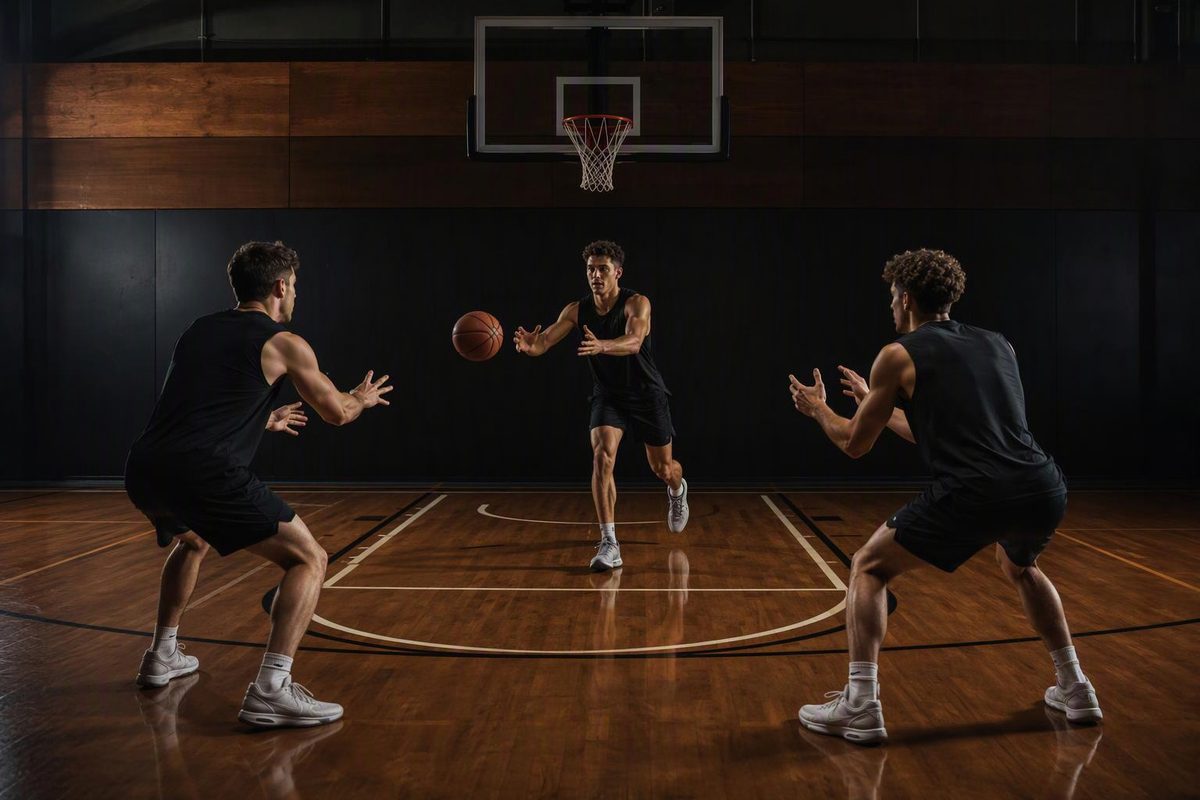
The basketball “basket weave” usually means the three-man weave: three players pass while crossing behind one another on the way to the basket. Use it as a short passing-and-movement warm-up, not as an offensive play.
What you need
- At least three players
- One basketball
- A full court for the traditional version
- One basket and half a court for the shorter version
You cannot run the actual weave alone because the pattern depends on three moving passers. A solo player can work on lead passes against a wall, but that does not reproduce the crossing pattern.
Full-court basket weave setup
Form three lines across one baseline:
- Put the middle line directly under the basket.
- Put one outside line near each corner or sideline.
- Give the ball to the first player in the middle line.
- Send the first player from each line together as one group of three.
Keep the outside lines wide enough to open passing lanes. Younger players who cannot comfortably cover the distance can start closer to the lane; stronger players can begin near the sidelines. This three-line baseline arrangement is also described by Basketball For Coaches.
Choose one traffic pattern before starting:
- Down and back: The same three players weave to the far basket and return. The next group waits until they finish.
- One-way waves: Each group stops and joins lines at the far baseline. The next group may leave once the previous group is safely beyond half court; after everyone crosses, run all groups in the other direction.
Do not combine the two formats. Sending a new group while the first group is returning creates opposing traffic in the same lanes.
The movement pattern
Teach the pattern at walking speed:
- Middle passes to either outside player. Begin with a chest pass.
- The passer runs behind the receiver. Pass, then arc around the back of the teammate who caught it.
- The receiver moves toward the middle and passes to the third player. After passing, that player also cuts behind the new receiver.
- Repeat up the floor. The ball moves from side to side while each passer crosses behind the teammate who received the pass.
- Finish with a layup. Send the last pass early enough for the finisher to gather under control. A bounce pass is a useful choice near the basket.
Do not dribble while learning the pattern. One documented traditional version allows no dribble except one if needed to finish the layup; it also calls for players to stay wide and cut behind the receiver (Coach’s Clipboard).
Passing and spacing cues
Give players one short cue for each job:
- Pass: Lead the receiver instead of throwing behind them.
- Catch: Show two hands and move toward the ball.
- Cut: Run behind the teammate you passed to.
- Space: Reopen wide after crossing the middle.
- Finish: Make the last pass early enough for a balanced gather.
Players can call the receiver’s name before passing. Communication helps, but the receiver should still show a target and the passer must put the ball in the receiver’s path.
Readiness checkpoint
Do not increase speed until the group completes three consecutive trips with:
- No dropped or bobbled passes
- Every passer cutting behind the receiver
- No two players staying in the middle lane together
- No dribbles before the finish
- A controlled final pass and layup
This is a practice standard, not an official rule. Once the group passes it at a walk, move to a jog. Require three more clean trips before running faster. If accuracy or spacing breaks down, return to the previous pace.
Fix players following the ball
A common error is for the passer to chase the ball or cut in front of the receiver. All three players then collapse toward the middle, closing the passing lanes and increasing the chance of a collision.
Correction: Use the cue, “Pass, behind, wide.” After releasing the ball, the passer arcs behind the receiver and continues into open space on the other side. If necessary, pause after every pass and point to the open outside lane before letting the passer continue.
If passes arrive behind the runner, slow the drill. Ask the passer to target the receiver’s front shoulder so the catch does not stop the receiver’s movement.
Half-court setup
When a full court is unavailable, place three lines at half court: left, middle and right. The middle player starts with the ball, passes to a wing and cuts behind. The wing passes across and cuts behind; the third player then gives the original passer a bounce pass for the layup.
This adapts the weave portion of a documented five-player half-court drill, which starts with the same three lines before adding jump shots, closeouts and rebounding (Breakthrough Basketball). The shorter version is easier to organize, but the final pass arrives quickly, so begin at a walk.
Keep the drill in its lane
The weave can rehearse catching, lead passing and coordinated running, but it is scripted and has no defender. Players do not normally weave up the floor during a live fast break, and critics of the drill argue that adding a defender creates more representative decisions (Basketball Immersion).
Use the weave briefly to establish clean movement. Then, if players are ready, progress to 3-on-1 transition so they must read a defender instead of following a fixed passing order.