
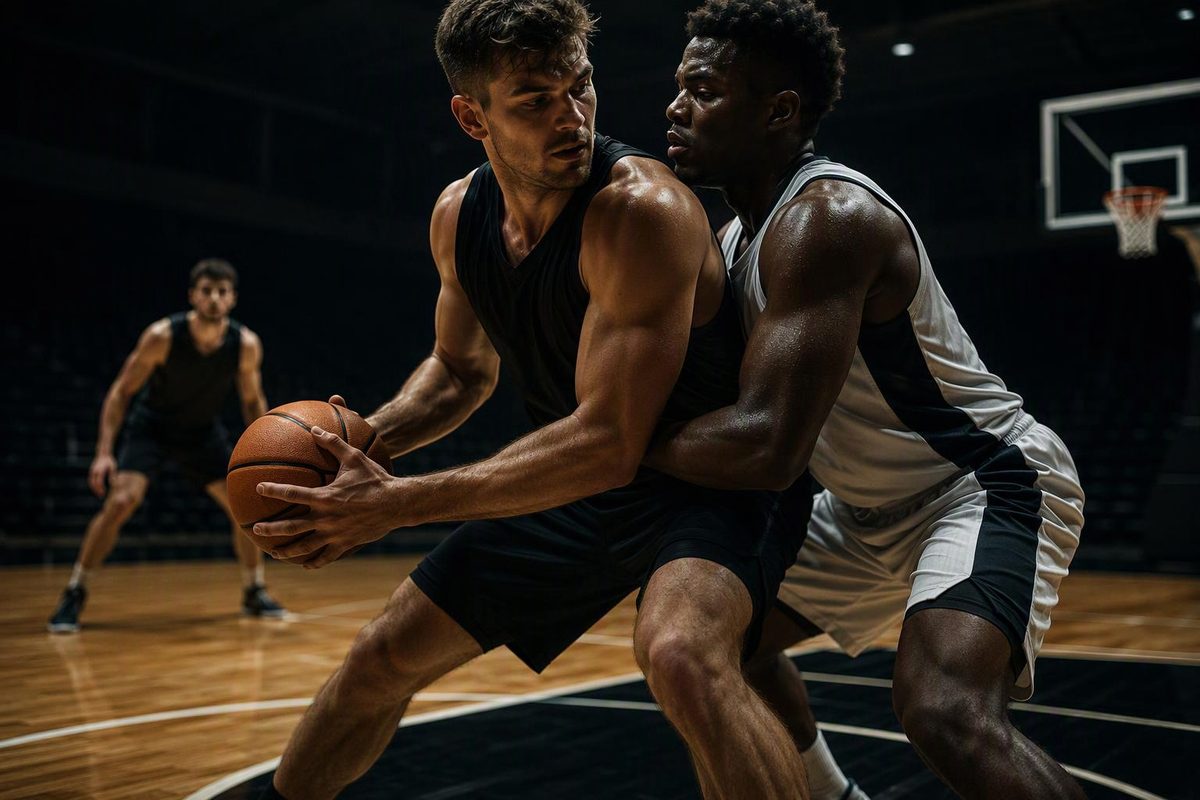
Post-play physicality is an NCAA men’s basketball point of emphasis for 2026-27, not a new category of foul. The contact standards already appear in the rules; officials are being directed to call the first foul, prevent displacement from established positions and address rough rebounding action consistently. The NCAA lists post play alongside offensive three seconds, freedom of movement and traveling as enforcement priorities for the season (NCAA).
For a post player, the practical rule is simple: contact can be legal; moving an opponent out of a legal spot is not.
What officials are looking for
The 2026-27 NCAA Men’s Basketball Rules Book tells officials to manage aggressive post play by calling the first foul and preventing players from dislodging opponents from legally established positions. It also directs officials to call rebounding fouls, including penalizing hook-and-hold actions with flagrant fouls.
Here is how the rules apply to common post actions:
| Post action | Rule standard |
|---|---|
| Offense posts with arms bent at the elbows | Legal if the arms do not hold or dislodge the defender |
| Offense uses a straight arm to keep the defender away | Foul when the arm wards off the defender or prevents legal guarding |
| Offense backs down and moves a legally positioned defender | Offensive foul |
| Offense leads through the defender with a shoulder | Offensive foul when the contact dislodges or disadvantages the defender |
| Defender uses one unextended arm bar in the post | Legal while it applies equal pressure and does not dislodge the opponent |
| Defender’s arm bar moves the post player | Defensive foul |
| Defender drives a knee or leg into the post player’s back | Defensive foul |
| Either player uses a “swim” motion to force down the opponent’s arm | Personal foul |
| Either player uses a hand, forearm or elbow to deny a legal position | Personal foul |
Under the rules book, a post player is an offensive or defensive player with their back to the basket in the post area. That area includes the lane and approximately three feet outside it. The defender’s permission to use one arm bar is specific to post play; it does not permit keeping a forearm on a player after that player faces the basket or begins a move to the basket.
Does a post player still get one bump?
The officiating guidelines say post players may be allowed one bump when the contact is equal. On a second bump, the official should determine who initiated the contact: a defender who moves the offensive player has fouled, while an offensive player who dislodges the defender by backing down or leading with a shoulder has committed an offensive foul.
Do not treat that wording as a guaranteed “free bump.” Rule 10-1.5 prohibits either player from dislodging an opponent by pushing, backing in or using a leg, knee or arm. If the first contact puts an opponent at a disadvantage, it can be called immediately. “One bump” describes equal contact that may be tolerated—not a right to knock the defender backward.
Cleaner offensive post technique
Build your move in this order:
- Win the spot before the catch. Arrive with a wide, balanced base instead of trying to shove the defender away after the ball comes.
- Keep both elbows bent. Show your hands as a target without straightening an arm into the defender.
- Catch and locate the defender. Chin the ball, stay balanced and feel where the pressure is coming from without hooking or holding.
- Use one controlled power dribble. Move your own feet and hips toward open space. Do not make moving the defender the purpose of the dribble.
- Pivot away from resistance. If the defender owns the direct path, turn to the open shoulder, use a counter or pass out.
Common miss: The player drops one shoulder and tries to drive through the defender’s chest. Correct it by keeping the shoulders closer to level and making the first step diagonal toward open court rather than straight backward through the defender.
Solo no-displacement post drill
This drill trains the body position you can control without pretending a cone provides real defensive contact.
Setup
- Ball and basket
- One cone, shoe or water bottle
- A strip of tape or existing court line
- Phone video from the baseline or side, if available
Place the marker on the lane line at a low-post spot. Treat the line through that marker as the defender’s legally established position. Start beside it with your back to the basket; do not touch or move the marker.
Action
- Show a target with both elbows bent.
- Self-toss the ball, catch it and chin it.
- Make one controlled power dribble while keeping your back shoulder from crossing through the imaginary defender’s space.
- Pivot toward the open side and finish with a jump hook or short bank shot.
- Repeat on the other block.
Perform five clean repetitions per side at half speed. Add speed only after all five meet the checkpoint.
Readiness checkpoint
Advance when you can complete five consecutive repetitions on each side while:
- keeping both arms bent before the catch;
- leaving the marker untouched;
- staying balanced through the dribble;
- pivoting into open space rather than driving backward through the line; and
- releasing the shot without an extra step or pivot-foot slide.
If your shoulder repeatedly crosses the defender line, shorten the power dribble and widen your base. The goal is not to remove all contact from post play. It is to create your move without needing illegal displacement.
Coaches can add a live defender after the player passes this checkpoint. Begin with light, steady forearm contact without trying to move the offensive player, then progress to guided resistance. Stop the repetition as soon as either player extends an arm, uses a knee, hooks an opponent or moves the other player off an established spot.