
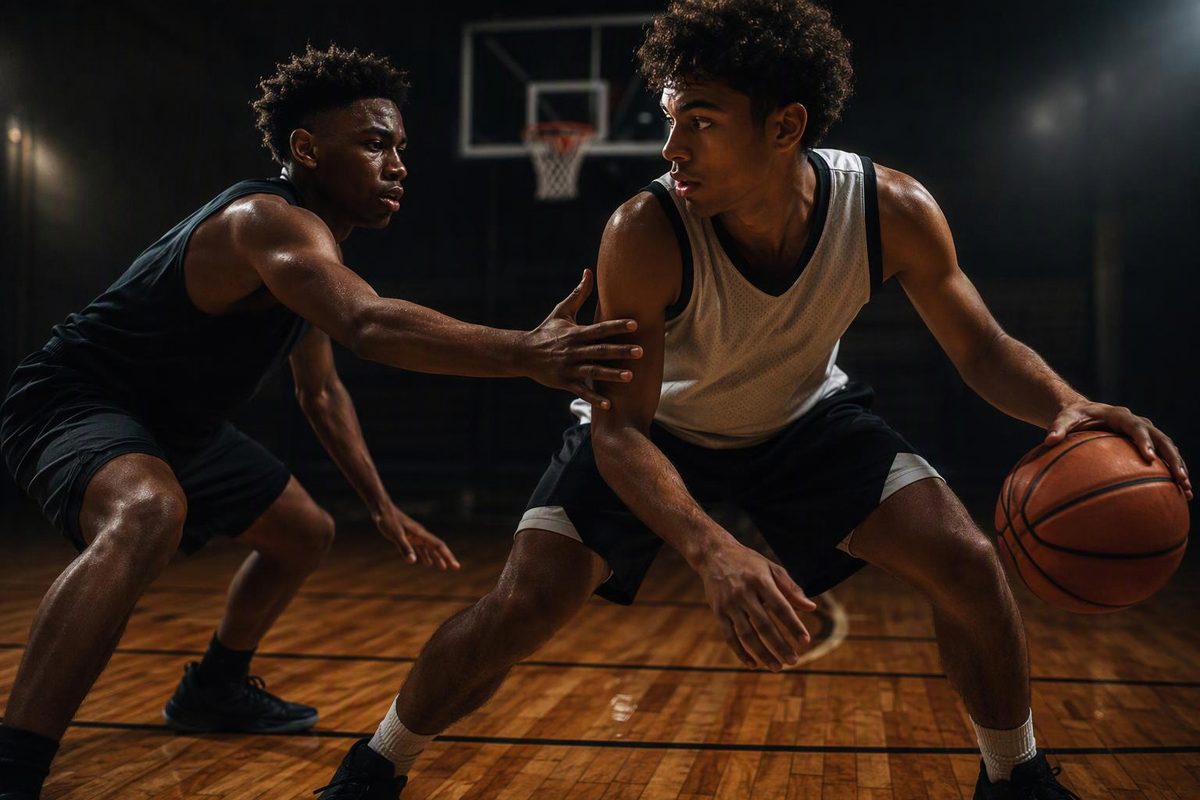
Hand checking is not a new foul for the 2026-27 high school basketball season. The NFHS made Physical Play and Illegal Contact a point of emphasis, directing officials to enforce existing rules against hand checks, displacement, controlling-arm push-offs and contact that restricts freedom of movement (NFHS 2026-27 points of emphasis).
Pick the play that matches your situation; the guide shows the likely ruling and correction.
Hand-Check Ruling Guide
Match the contact to the closest listed play. Officials still judge the complete action and its effect.
Putting two hands on a ball handler or dribbler is one of the listed hand-check fouls.
Correction: Remove both hands, establish legal guarding position and contain with the feet and torso.
Quick Reference
Two hands on a dribbler — Foul
Putting two hands on the ball handler is a listed hand-check action.
Extended arm bar — Foul
An arm bar cannot be used to control, impede, divert or slow an opponent.
One hand kept on — Foul
Placing and keeping one hand on the player is a listed hand-check action.
Repeated hand contact — Foul
The standard covers repeated contact with the same hand or alternating hands.
Legal torso position without steering — Generally legal
A defender may move laterally and maintain legal guarding position without using the hands or forearm to steer.
Momentary touch — Context matters
A brief touch is not permission to steer. Contact that redirects, slows, pushes or prevents movement can be illegal.
Offensive extended-arm push-off — Foul
An attacker cannot extend the controlling arm to create separation or displace a defender.
Post displacement — Foul
Two hands on the back, forearm displacement and dislodging a legally positioned opponent are identified as illegal.
Source: NFHS 2026-27 Physical Play and Illegal Contact point of emphasis and NFHS guarding guidance.
Four Defensive Actions Constitute Hand Checking
Against a ball handler or dribbler, these defensive actions constitute a foul:
- Putting two hands on the player
- Using an extended arm bar
- Placing and keeping one hand on the player
- Contacting the player repeatedly with the same hand or alternating hands
These standards predate the 2026-27 season. An NFHS guarding guide lists all four and explains that a player cannot use the hands, arms or body to control, hold, impede, push, divert or slow an opponent (NFHS guarding guidance).
A momentary touch is not permission to steer the dribbler. Contact can be illegal when it pushes, redirects, slows or prevents movement. The practical defensive cue is to guard with your feet and torso rather than leaving a hand or forearm on the opponent.
The Enforcement Priority Changed, Not the Standard
The published 2026-27 rule changes address clock operation, timing corrections, offsetting technical fouls and throw-in administration. Physical Play and Illegal Contact appears separately on the points-of-emphasis list (TASO summary of the NFHS changes).
That distinction matters. A point of emphasis does not turn every instance of body contact into a foul. Defenders may establish and maintain legal guarding position. The enforcement focus is illegal contact that creates an advantage, displaces an opponent or restricts freedom of movement.
Officials still judge the complete play. Legal torso contact from an established guarding position is different from using a hand or forearm to control where an opponent can move.
Perimeter Defenders Cannot Steer the Dribbler
A defender may move laterally in front of a dribbler but cannot guide the player with a hand on the hip or repeatedly jab the body. A forearm used to slow or redirect the dribbler is also illegal.
The legal target is to beat the dribbler to the spot, keep your torso in the path and move your feet without using your hands to steer. If the attacker changes direction, recover with a drop step and slide rather than reaching across the body.
Visible hands can help remove the habit, but hand position alone does not decide the call. A defender with raised hands still needs legal guarding position, while a brief touch is not automatically equivalent to placing and keeping a hand on the opponent. The action and its effect matter.
Post Contact Becomes Illegal When It Displaces
The NFHS point of emphasis specifically identifies two hands on an opponent’s back, forearm displacement and dislodging a legally positioned opponent as illegal.
A post defender should maintain a balanced, legal position with the hands visible. The goal is to absorb contact without pushing the opponent out of position or using a forearm as a lever.
The same principle applies away from the ball. A player cannot hold, impede or divert an opponent merely because the matchup is not involved in the immediate dribble action.
Offensive Push-Offs Are Part of the Emphasis
The emphasis is not limited to defenders. An offensive player cannot extend the controlling arm to push off, create separation or displace a defender. In the post, backing in becomes illegal when it dislodges an opponent from an established position. NFHS guarding guidance also identifies offensive hooks, forearms and push-offs as fouls.
An attacker should create separation with footwork, pace and changes of direction rather than an extended arm. Keeping the off arm within a natural movement is different from straightening it into a defender to make space.
Train Containment Without Reaching
The hands-free containment slide removes the reaching habit before a live dribbler is added.
Set Up the Lane
Place two cones or shoes 8 to 10 feet apart. Mark a starting point about 6 feet behind the midpoint. Hold a small towel across the back of your neck, gripping one end in each hand.
The towel makes it obvious when you try to recover with an arm instead of your feet. The NFHS guarding guide describes the same towel concept as a way to train defenders not to use hand or arm bars.
Complete Each Repetition
- Close out from the starting mark to the midpoint using short, controlled steps.
- Settle into a defensive stance with your hips down, chest up and feet slightly wider than your shoulders.
- Slide to one cone without crossing your feet.
- Push off the outside foot and slide through the middle to the other cone.
- Finish under control, then repeat for 15 seconds.
Complete three rounds. Remove the towel and repeat with both hands visible.
Pass the Readiness Checkpoint
Advance to live one-on-one containment only when you can complete all three rounds while:
- Keeping both hands visible
- Avoiding crossed feet
- Keeping your chest facing the imaginary dribbler
- Stopping at each cone without leaning or reaching
If a hand drops whenever you change direction, slow down. The usual breakdown occurs when the feet lose position and the defender tries to recover with an arm. Correct it with a quick drop step and recovery slide instead of reaching across the attacker.
Once the footwork is stable, add a partner in a narrow lane and defend at half speed. The defender wins by staying in front through three controlled changes of direction, not by touching the ball handler.
For another 2026-27 enforcement priority affecting attacking footwork, see the NFHS traveling point of emphasis.