
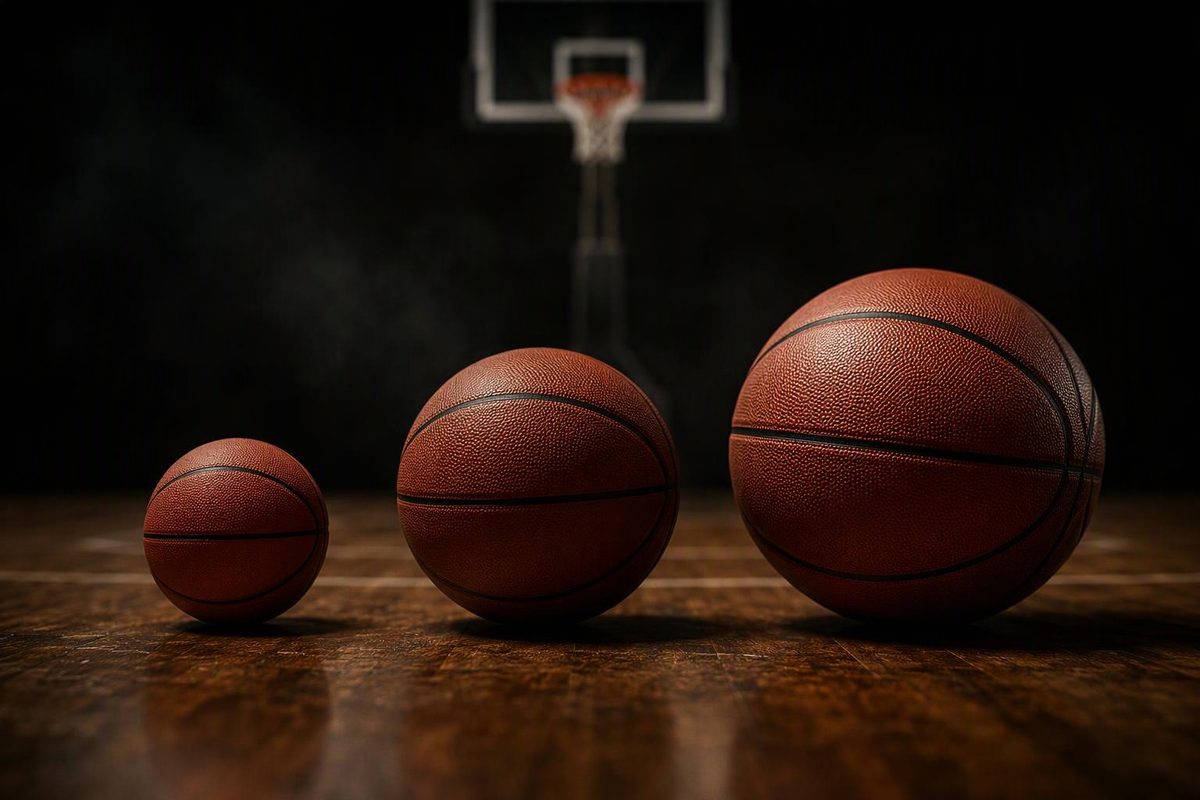
A size 3 basketball is a mini basketball, usually about 22 to 22.5 inches (56–57 cm) in circumference. Wilson specifies 22.5 inches and 10 ounces for its size 3 ball, while Spalding Australia lists a 22-inch circumference. Check the individual product because dimensions can vary slightly by brand (Wilson; Spalding Australia).
A size 3 can suit:
- Very young beginners learning to catch, pass and dribble
- Small indoor or over-the-door hoops
- Close-range coordination drills
- Players who cannot yet control a larger youth ball
Age labels are not consistent across manufacturers. Wilson recommends size 3 for children age 4 and under, while Spalding Australia describes it as a novelty mini ball suitable for all ages. Treat those labels as product guidance, not league rules.
Size 3 compared with larger basketballs
| Ball | Typical circumference | Common use |
|---|---|---|
| Size 3 | 22–22.5 inches | Mini hoops and introductory play |
| Size 5 | 27.5 inches | Youth competition and practice |
| Size 6 | 28.5 inches | Older youth and women’s play |
| Size 7 | 29.5 inches | Older boys’ and men’s play |
Size 3 is not among the game-ball sizes specified in major youth guidance. USA Basketball recommends a size 5 ball with a 27.5-inch circumference for boys and girls ages 7–8, followed by size 6 for ages 9–11 (USA Basketball). FIBA’s 2026 equipment rules specify size 5 or lightweight size 5 for mini-basketball, size 6 for women’s competition and size 7 for men’s competition; they do not list size 3 (FIBA equipment rules).
Do not confuse size 3 with 3x3 basketball. The first is a mini-ball size; the second is a form of the game.
Should a child use size 3 or size 5?
Use a ball small enough for the player to learn the movement without forcing it, but practice with the competition ball once the player can control it.
A size 3 may be a useful starting point when the player:
- Cannot catch a size 5 cleanly with two hands
- Loses the ball on nearly every waist-high dribble
- Must push a close shot upward from the hip
- Is playing on a mini hoop rather than a regulation basket
Choose size 5 if the player is entering a league that uses it or already controls it comfortably. USA Basketball says a smaller ball gives younger players better control, but its organized-play recommendation begins with size 5 at ages 7–8—not size 3. Check the local league’s rules before buying a game ball.
A simple size 3 practice progression
Use a flat, clear space and a wall or low hoop. Advance only when the player reaches the checkpoint without rushing.
1. Stationary control
Setup: Stand with feet about shoulder-width apart and hold the ball at waist height.
Action: Move the ball around the waist five times in each direction. Then pass it gently from hand to hand in front of the body for 20 catches.
Checkpoint: Complete 20 exchanges without trapping the ball against the body or chasing it.
Common miss: If the ball strikes the palms and bounces away, soften the elbows and receive it with spread fingers.
2. Waist-high dribbling
Setup: Bend the knees slightly and keep the non-dribbling hand beside the body.
Action: Dribble 10 times with the right hand, then 10 with the left. Push down on the top of the ball with the finger pads rather than slapping underneath it.
Checkpoint: Make 10 consecutive dribbles on each side while keeping the bounce no higher than the waist.
Common miss: If the ball drifts forward, contact it closer to the top instead of reaching around the back.
3. Walk-and-stop dribbling
Setup: Mark a line about 10 feet away with chalk or a flat object that will not cause a trip.
Action: Walk to the marker while dribbling, come to a balanced two-foot stop, then return while using the other hand.
Checkpoint: Complete four trips without losing the ball and stop under control each time. Only then add speed.
Common miss: If the ball gets too far ahead, shorten both the steps and the dribble.
4. Close shooting
Use a mini hoop or an appropriately lowered basket. Start close enough that the player does not have to heave the ball. USA Basketball recommends an eight-foot basket for ages 7–8, explaining that a lower target supports suitable form and more attainable attempts (USA Basketball). A younger beginner may need a lower recreational hoop.
Place the ball in front of the shooting side, bend the knees and finish with the shooting arm extended and wrist relaxed. Make five shots without twisting the body before stepping back. For the complete sequence, use this proper shooting form progression.
Checkpoint: The ball travels toward the hoop while the player stays balanced and finishes with the shooting hand above the shoulder.
Common miss: If the player throws from the hip with two hands, move closer or lower the hoop. Do not preserve distance at the cost of the motion.
When to move up from size 3
The following are practice checkpoints, not official age or competition standards. Test a size 5 after the player can:
- Catch 10 gentle chest passes in a row.
- Dribble 20 times with either hand while standing still.
- Walk 20 feet and stop without losing control.
- Shoot close to the basket without leaning backward or launching from the hip.
Repeat the tests with a size 5. If the actions remain controlled, use size 5 for most practice—especially when it matches the player’s league. Keep the size 3 for mini-hoop play and simple coordination work, but do not let it replace regular practice with the ball used in games.