
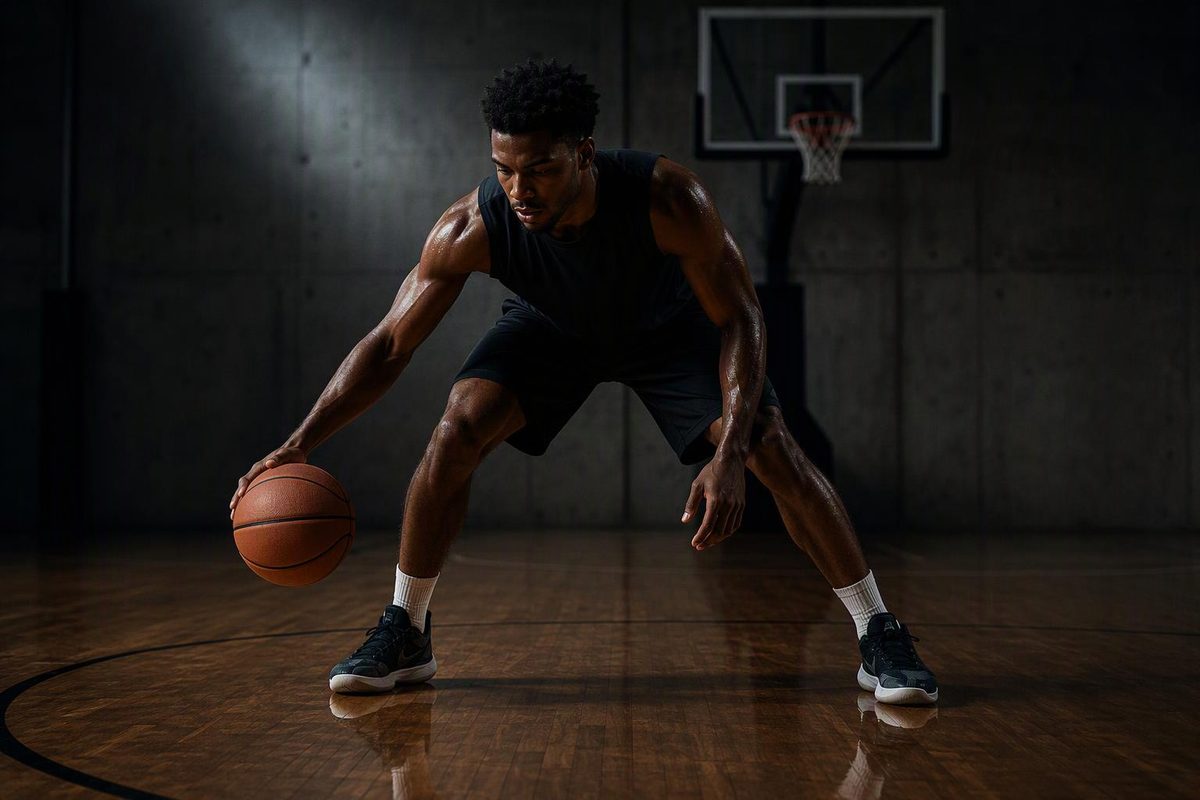
Use this sequence to practice controlling the ball while stationary, changing direction and moving at speed. You need one basketball, three markers and about 15–20 feet of clear, level space. A hoop is optional.
Pass each checkpoint at a controlled pace before trying to go faster.
Start with the right dribbling position
Stand with your feet just wider than hip-width, knees bent and chest up. Push the ball into the floor with a relaxed wrist rather than slapping it. Keep your hand on the top half of the ball and receive the rebound softly before pushing again. USA Basketball’s basic dribbling guidance places a control dribble just in front of and beside the body, no higher than the waist.
Look forward instead of following every bounce. Jr. NBA also cues players to keep their chest and eyes up, use their fingertips and stay low during its stationary crossover and cone drills.
1. Stationary pound dribbles
Setup: Stand in an athletic stance with the ball beside your right foot.
Action: Dribble at knee height for 20 seconds. Push each bounce firmly enough that the ball returns quickly, but keep your shoulder and wrist relaxed. Repeat with the left hand. Complete three rounds per hand.
Checkpoint: Make 30 consecutive dribbles with each hand while looking at a point ahead. Keep the ball outside your foot and below your waist.
Common miss — the ball drifts forward: Move your hand slightly behind the ball on contact and aim for a floor target beside your shoe.
2. Low-middle-high ladder
Setup: Stay stationary with your feet wide and knees bent.
Action: With one hand, dribble for 10 seconds below the knee, 10 seconds around knee height and 10 seconds between the knee and waist. Come back down through the middle and low levels without stopping. Do one 50-second ladder with each hand.
This adapts the level changes in the Jr. NBA practice plan. Changing bounce height requires you to adjust the force of the dribble without losing your stance.
Checkpoint: Complete the ladder with each hand, eyes forward and no loss of control.
Common miss — standing up as the bounce rises: Keep your hips at one height. Change the force of the dribble, not your body position.
3. Front and side V-dribbles
Setup: Begin with the ball in your right hand and your feet stationary.
Action: For a front V-dribble, push the ball diagonally toward the center of your body, receive it with the same hand and push it back outside. For a side V-dribble, move the ball forward and backward beside your right foot. Work for 20 seconds in each direction, then switch hands. Complete two rounds.
Your hand can move around the upper side of the ball to direct it, but do not let the ball pause underneath your palm.
Checkpoint: Make 20 sharp V-dribbles in a row in each direction with each hand while keeping both feet still.
Common miss — chasing a wide bounce: Shrink the V until every rebound reaches the same hand comfortably. Widen it only after the pattern is consistent.
4. Stationary crossover
Setup: Stand wider than shoulder-width with the ball outside your right knee.
Action: Push the ball low and diagonally across your body. Receive it outside the opposite knee, then cross back. Shift your weight from foot to foot while keeping your chest forward. Complete three sets of 20 seconds.
Checkpoint: Make 20 crossovers below knee height without bringing your feet together or looking down.
Common miss — bouncing at the center of your stance: Aim outside the opposite shoe. Finishing in the middle leaves the ball exposed and gives you no angle to move.
5. Zigzag change-of-direction drill
Setup: Place three markers in a line, each 5–6 feet apart. Start just outside the first marker.
Action: Dribble diagonally toward a marker. As you plant the outside foot, cross the ball below your knees and push toward the next marker. Turn around after the last marker and return. Complete four trips, starting twice with each hand.
Jr. NBA’s cone drill similarly has players switch hands while changing direction and push off the outside foot. Treat each marker as a defender’s position, not an object to circle.
Checkpoint: Finish three trips without hitting a marker, losing the ball or needing an extra sideways dribble after the crossover.
Common miss — ball and foot move separately: Time the low crossover with the outside-foot plant, then push off into the new direction.
6. Retreat-and-re-attack drill
Setup: Place one marker 8–10 feet in front of you and another 6 feet beyond it.
Action: Attack the first marker with your right hand. Take two backward dribbles while keeping your body between the marker and ball. Square your hips, crossover and accelerate past the second marker. Repeat on the other side. Perform five reps each way.
The Jr. NBA retreat-dribble progression also uses two retreat dribbles before the player squares up and advances; it later adds a crossover or between-the-legs move.
Checkpoint: Complete 8 of 10 reps with exactly two retreat dribbles, a controlled hand change and no crossed feet while moving backward.
Common miss — retreating upright: Sit your hips back and keep the dribble below your waist. If you lose balance, slow down and shorten the backward steps.
7. Change-of-pace attack
Setup: Use three markers to create a straight 15–20-foot lane.
Action: Begin with two slow control dribbles. Hesitate briefly at the first marker, keeping your hand on top of the ball, then push the next dribble ahead and sprint past the final marker. Alternate hands. If you have a hoop, finish with a layup; without one, gather into a balanced jump stop. For more jump-stop work, use this solo basketball footwork progression.
Checkpoint: On 8 of 10 reps, show three distinct rhythms—a controlled approach, brief hesitation and burst—without changing hands or losing the ball.
Common miss — the dribble speeds up but the player does not: Push the attack bounce farther ahead and drive off the foot opposite the ball. Your body and the ball should accelerate together.
A 20-minute solo workout
Run the drills in order:
- Pound dribbles: 2 minutes
- Low-middle-high ladder: 2 minutes
- Front and side V-dribbles: 3 minutes
- Stationary crossover: 2 minutes
- Zigzag changes: 4 minutes
- Retreat and re-attack: 4 minutes
- Change-of-pace attacks: 3 minutes
Record successful reps rather than counting only time. When you pass a checkpoint in two consecutive sessions, increase the pace. If control repeatedly breaks down, return to the last speed at which you could keep your eyes up and the ball in its intended lane.
These drills isolate dribbling control. Ball handling in a game also includes passing, decision-making and reading defenders, as this coaching overview of dribbling and ball handling explains. Once the solo sequence is stable, use the same moves against a partner or live defender rather than adding endless stationary combinations.