
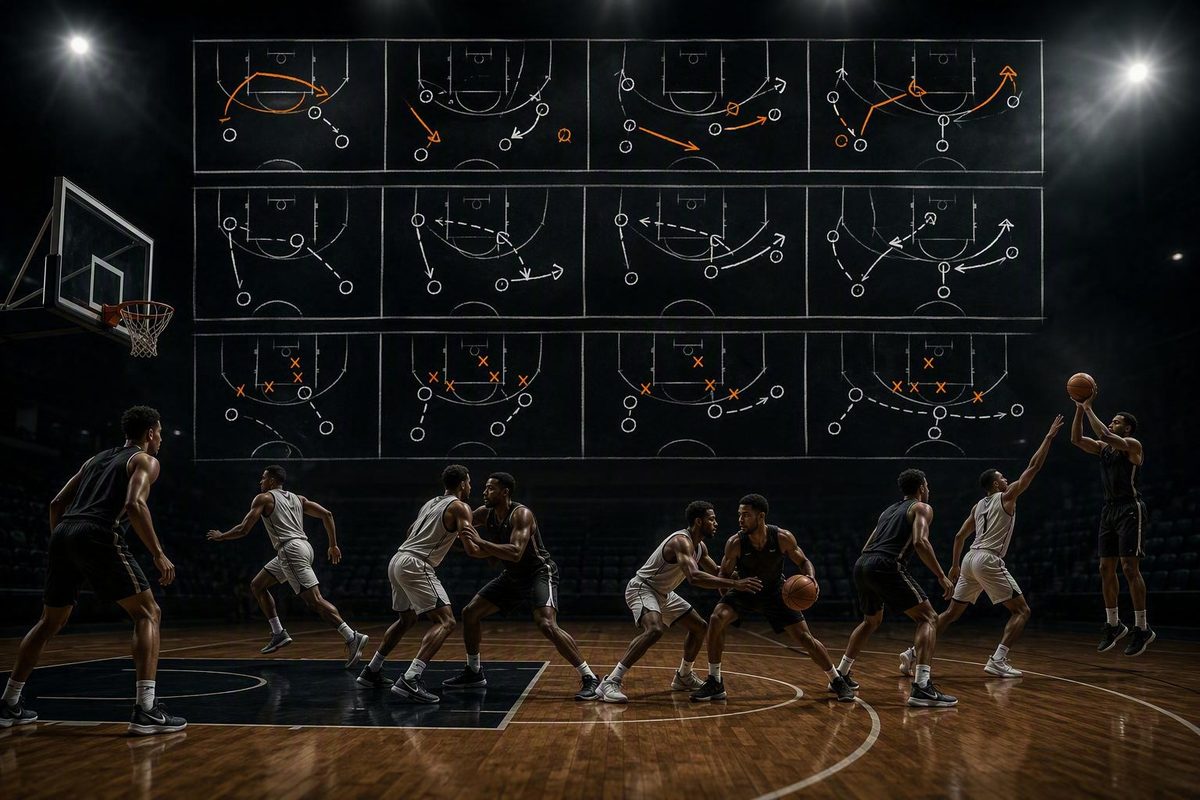
At its best, Flex offense basketball gives a team repeatable half-court structure without requiring every possession to end the same way. Its familiar pattern—a baseline flex cut followed by a downscreen—provides the framework. The offense becomes functional when players recognize whether defenders trail, switch, deny, help, or anticipate.
That changes the installation goal. Do not merely teach five players where to run. Teach the alignment, connect the two screening actions, establish an order of scoring reads, and add defensive responses one at a time. Players can then repeat the continuity when nothing is open and interrupt it immediately when the defense concedes an advantage.
What the Flex offense is—and what it is not
The Flex is a patterned continuity offense built around passing, off-ball screens, cuts, ball reversal, and rotation through court positions. In a common version, a pass across the top triggers a baseline cut off a low cross-screen. The original passer then downscreens for the player who set that first screen.
Those linked actions create a screen-the-screener sequence:
- A low player screens for a baseline cutter.
- The original passer screens down for that low screener.
- The ball reverses.
- The actions repeat on the other side.
A continuity differs from a one-time set play because it returns the offense to a reusable alignment. If neither the baseline cutter nor the player using the downscreen is open, the team can reverse the ball and reproduce the same reads on the opposite side. This baseline cut, downscreen, and reversal form the basic structure shown in the Coach’s Clipboard Flex guide.
Not every possession has to begin in the standard Flex alignment. A transition flow, 1-4 high action, dribble entry, or quick hitter can create the first scoring opportunity. If that action produces no advantage, the players relocate into Flex positions and continue through the underlying continuity.
Flex is also not unrestricted motion offense. In a freer motion system, players may respond to broad spacing and movement rules without returning to one prescribed sequence. Base Flex uses a more defined rotation. Coaches can still add back cuts, slips, drives, post seals, and replacement rules, but those decisions sit on top of a recognizable pattern.
A common presentation is 4-out, 1-in: four players occupy perimeter locations while one operates near a low block or lane line. Other versions begin from 1-4 high, 1-4 low, or transition; use different numbering conventions; or widen and adjust the perimeter spots.
Standard Flex is principally presented as an offense against man-to-man defense. Its screens affect defenders who must follow cutters, switch assignments, or help away from individual matchups. Zone adaptations are possible, but they materially change the spacing and screening responsibilities.
The offense’s origin should not be presented as settled. A tertiary account attributes it to Rene Herrerias at California in 1967, while also noting that its own sourcing is unclear (Wikipedia’s Flex offense history). A separate coaching guide attributes a shuffle-offense variation to Carroll Williams at Santa Clara in the 1970s (Basketball for Coaches). Because those accounts conflict and neither establishes a definitive primary-source history, teaching the offense does not require choosing an undisputed inventor.
Starting alignment and one complete Flex cycle
Because terminology varies, this guide uses one numbering system throughout:
- Player 1 (P1): left slot, starting with the ball.
- Player 2 (P2): right slot.
- Player 3 (P3): left corner, initially the weak-side cutter.
- Player 4 (P4): right corner, initially the strong-side spacer.
- Player 5 (P5): left low block or lane line, initially the flex screener.
“Strong side” means the side containing the ball. “Weak side” means the side away from it. These labels describe starting responsibilities, not permanent positions; every player will eventually pass, cut, screen, and occupy interior and perimeter locations.
Here is the starting alignment, viewed from half court toward the basket:
                  HALF COURT

             P1 ●             P2
          left slot        right slot


       P3                         P4
   left corner                right corner

             P5
       left low block

               [ BASKET ]
The symbol ● identifies the ball. The diagram is schematic rather than to scale.
First trigger: the top pass
P1 passes across the top to P2. That pass starts the coordinated action; it is not merely a way to move the ball between guards.
As the pass travels, P5 establishes a cross-screen near the lane for P3. P3 leaves the weak-side corner and cuts along the baseline toward the right block. P2 looks first to P3.
The cutter should not blindly run into the middle of the screen. P3 reads the defender’s location and selects the tightest useful route. If the defender trails above the screen, P3 can cut close to P5 and continue toward the rim or right block. If the defender jumps below the expected route, P3 can adjust to use the space that defender has conceded.
The timing connects three events:
- P1 releases the pass.
- P5 establishes the flex screen.
- P3 changes pace and cuts off it.
If P3 leaves too early, the screen may not be set. If P3 leaves too late, the defense can anticipate the route while P2 holds the ball.
Second action: screen the screener
If P3 is not open, P1 immediately moves down to screen for P5. This is the downscreen portion of the continuity.
P5 waits for the screen and then rises toward the left elbow or slot. P2 looks for the catch there. After screening, P1 clears to the vacated left corner so P5 has room to receive the ball and the team retains its perimeter spacing.
After the first half-cycle, the players occupy these locations:
| Player | Location | Responsibility |
|---|---|---|
| P1 | Left corner | Space after setting the downscreen |
| P2 | Right slot with the ball | Read the cutter, downscreen, or reversal |
| P3 | Right block or short corner | Finish the cut and seek inside position |
| P4 | Right corner | Hold width |
| P5 | Left slot or elbow area | Receive the reversal or attack a late closeout |
                  HALF COURT

             P5              P2 ●
          left slot        right slot


       P1                         P4
   left corner                right corner

                              P3
                         right block

               [ BASKET ]
Complete the mirrored half
P2 now reverses the ball to P5. During that pass:
- P3, now on the right block, becomes the low flex screener.
- P4 cuts from the right corner along the baseline off P3’s screen.
- P5 reads P4 first.
- If P4 is covered, P2, the original passer, downscreens for P3.
- P3 rises toward the right elbow or slot.
- P2 clears to the right corner.
At the end of the complete cycle, the alignment is:
| Player | Location after the full cycle |
|---|---|
| P1 | Left corner |
| P2 | Right corner |
| P3 | Right slot |
| P4 | Left block or short corner |
| P5 | Left slot with the ball |
The offense has returned to the same positional structure with new players filling the roles. P5 can pass across to P3, P4 can screen for P1’s next flex cut, and P5 can then downscreen for P4.
The useful memory cue is:
Flex cut, downscreen, reversal, repeat.
That describes the action order, not an obligation to ignore scoring opportunities. The cutter and downscreened player are live options. A seal, post entry, drive, or open shot may interrupt the continuity before the next reversal.
The scoring reads in priority order
A common installation mistake is rewarding players for completing the pattern rather than reading it. The offense then appears organized in five-on-zero practice but applies little pressure when defenders are added.
Teach each cycle as an ordered sequence of reads.
1. Read the flex cutter
When the top pass triggers the low cross-screen, the ball handler first checks the cutter near the basket. The passing window may be brief, so the receiver should see the action before catching and be ready to pass immediately.
The cutter should:
- Wait for the screen to arrive.
- Change speed before using it.
- Cut shoulder-to-shoulder with the screener.
- Show a clear target hand.
- Locate the ball without drifting away from the basket.
- Finish at the block or short corner if no pass comes.
The route responds to the defender. Against a trailing defender, complete the cut into the close passing window. Against a defender who goes underneath or jumps the route, adjust around the screen rather than colliding with the coverage.
2. Read the player using the downscreen
If the cutter is covered, the passer looks at the second linked action. The original flex screener uses the downscreen and rises toward the elbow, high post, or slot.
A catch there can lead to:
- A balanced shot within the player’s range.
- A catch-and-drive against an off-balance closeout.
- A post feed to the flex cutter.
- An immediate reversal.
- A team-specific handoff or continuation.
Receiving the ball does not by itself mean the action succeeded. The player must still assess balance, range, defender position, help, and the next passing window.
3. Read the screener’s seal
The flex screener should not become inactive after contact. If the defense switches, the screener may be able to open toward the ball and seal the new defender.
The flex cutter can do the same after reaching the opposite block. The cutter should stop, establish useful inside position, and present a target. The passer should enter the ball only when the angle is safe.
A switch may disrupt the intended cut while creating a different opportunity. Neither result is automatic. The offense has to identify the matchup, decide whether a positional advantage exists, and deliver the ball before help closes the window.
4. Consider the post entry
The cutter or screener may gain inside position even when the immediate layup pass is unavailable. A post entry can then become a secondary option.
On the entry, the other players must stay out of the lane and maintain visible passing windows. Crowding the post removes space for the move and the kick-out.
5. Use extensions without losing the structure
Options that can grow from the base reads include:
- A corner pass followed by a give-and-go or screening action.
- A basket cut when a defender overplays the passer.
- A drive against a hard closeout.
- A kick-out when help collapses.
- A dribble entry against a denied reversal.
- A slip when a defender leans early into a screen.
These are responses, not promised outcomes. A corner catch does not guarantee a shot, and paint penetration does not guarantee a clean kick-out. When an option disappears, players can preserve spacing, reverse the ball, and restart the priority reads from the other side.
Role-by-role checklist
Passer
- See the cutter before catching.
- Deliver the close pass on time or advance to the next read.
- Do not stare at a covered cutter.
- After passing, sprint into the downscreen.
- Clear to the assigned space.
Flex cutter
- Set up the defender before leaving the corner.
- Wait for the screen.
- Read the defender’s hip and route.
- Cut tightly and show a target.
- Finish at the block, seal, or clear according to team rules.
Flex screener
- Arrive early and under control.
- Use an angle that forces the defender to choose a route.
- Stop and establish position before the cutter arrives.
- Open toward the ball or seal after the cutter clears.
- Prepare to use the downscreen instead of watching the pass.
Down-screener
- Move when the cutter’s passing window closes.
- Screen the defender rather than a memorized patch of floor.
- Arrive under control before expected contact.
- Communicate if the team uses screening calls.
- Clear decisively after the action.
Weak-side spacer
- Maintain width and vision.
- Avoid drifting into the cutter’s destination.
- Prepare for a reversal, skip, or kick-out.
- Relocate only when the spacing rules require it.
- Anticipate the mirrored action without moving early.
Spacing, timing, passing and screening details
Flex becomes crowded when players know their routes but not the relationship between actions. The pass, baseline screen, cut, downscreen, and reversal must occur in sequence.
An early cutter arrives before the screen. A late cutter allows the defender to lock onto the route. A passer who catches and waits gives help defenders time to load the lane. A down-screener who leaves too soon can enter the cutter’s passing window.
Teach cuts as changes of pace
The flex cutter should not run at one speed and loop around the screen. Teach this sequence:
- Hold the corner long enough to occupy the defender.
- Step or lean away from the intended route.
- Accelerate toward the screener.
- Cut tightly off the screener’s shoulder or hip.
- Show a target as the window opens.
- Finish at a defined landmark.
A looping cut leaves room for the defender to slide between the cutter and screener. It also lengthens the pass and can carry the cutter away from the scoring area.
Teach screens as angles, not collisions
The screener’s purpose is to influence the defender’s route, not seek contact. Teach the player to arrive under control, stop before the cutter uses the screen, maintain balance, and choose an angle that supports the intended route.
After the cutter clears, the screener should open to the ball, seal, or prepare to use the next screen. Standing and watching wastes the screen-the-screener relationship.
This article is not an authoritative rules guide. In practice, observe the screener’s arrival, balance, movement, spacing, and timing rather than treating a written cue as a complete ruling.
Protect the passing lanes
Perimeter players need enough separation that one defender cannot easily crowd two receivers. One coaching implementation uses 15 to 18 feet as an installation reference, but that is not a universal rule. Appropriate spacing depends on player range, court dimensions, age, ball pressure, and the chosen landmarks (Hoops Lab’s timing and screening guide).
The relationships matter more than one measurement:
- The corner should not drift into the low screen.
- The slots should preserve the reversal lane.
- The down-screener should clear the receiver’s route.
- The weak-side spacer should not fill the block before the cutter leaves.
- Drivers should retain an exit pass when help enters the lane.
Use fixed landmarks during initial installation. Floor markings, cones outside the playing area, or named spots can help players learn the rotation. Once defenders are added, players should preserve the purpose of those landmarks while adjusting within them. A player might widen to improve a passing angle or shorten a cut to seal a switch, but should not abandon the spacing structure randomly.
Keep the ball ahead of the defense
Crisp reversal matters because the offense is moving defenders from one responsibility to the next. The passer should catch ready to pass, shoot, or drive. Holding the ball while the off-ball action finishes gives defenders time to communicate and recover.
Pass fakes can move help or soften denial, but they should produce a decision. Repeated fakes that do not change the defense only slow the continuity.
Troubleshooting common breakdowns
| Problem | Likely cause | Coaching correction |
|---|---|---|
| Crowded lane | Corner drifts early or cutter stops in the middle | Assign exact finishing spots and require the next player to hold width |
| Looping flex cuts | Cutter starts too far from the screener | Use a cone or pad to demand shoulder-to-shoulder cuts |
| Illegal or ineffective screen position | Screener arrives late, moves into contact, or chases the defender | Start the screener earlier, require control, and review the applicable rules |
| Slow reversals | Receiver catches without seeing the next side | Teach “eyes early, hands ready” and use a brief catch limit |
| Players watch the ball | Responsibilities end after the first action | Grade the screener’s second action and the cutter’s finish |
| Two players fill one spot | Rotation rules are unclear | Freeze play, identify the vacated location, and name who fills it |
Correct one cause at a time. Stopping every repetition for several unrelated details prevents players from developing the rhythm the drill is meant to teach.
How to counter the defense’s coverage
A counter should answer a visible defensive cue. Randomly adding cuts because the base pattern appears predictable usually damages timing and spacing. Players need to know what they saw, what response that cue triggers, and where the next pass should go.
| Defensive behavior | Visual cue | First offensive response | Next pass |
|---|---|---|---|
| Defender trails the flex cutter | Defender follows behind the cutter’s upper hip | Complete the tight flex cut | Pass near the rim or block |
| Defense switches the flex screen | Screener’s defender takes the cutter | Cutter or screener seals the new matchup | Timely post entry or high-low pass |
| Guard-to-guard reversal is denied | Top defender steps above or into the lane | Back cut, dribble entry, corner pass, or give-and-go | Pass to the cutter, corner, or replacement |
| Defender shoots the gap | Defender leaves early to beat the expected route | Cut behind the defender | Direct backdoor pass |
| Cutter is top-locked | Defender positions above the cutter | Slip, re-screen, flare, or cut away | Pass to the slip, flare, or replacement |
| Coverage leans aggressively toward the screen | Two defenders commit toward the cutter or receiver | Slip before contact or change the angle | Pass to the screener or reverse into the vacated space |
| Help collapses into the lane | A perimeter defender leaves a spacer | Hold width and present an outlet | Kick out and make the extra pass if needed |
| Defense sags under the action | Defenders protect the lane rather than follow tightly | Use available shooting space or improve the screen angle | Reverse until a balanced shot, drive, or entry appears |
Against a trailing defender, complete the intended flex cut first. Do not abandon a useful route merely because counters have been installed. The passer checks the close catch before moving to the downscreen or reversal.
Against a switch, stop treating the offense as an automatic loop. The cutter can seal the screener’s original defender at the block, while the screener can open against the defender left after the exchange. The passer must recognize the switch early enough to enter the ball before help resets.
If the guard-to-guard pass is denied, do not force it. The denied receiver can back cut. The ball handler can use a dribble entry, pass to the corner, or trigger a give-and-go. The team should select one defined rule rather than allowing all five players to improvise simultaneously.
When a defender shoots the gap, the available space is often behind that defender. A direct backdoor cut attacks that space more cleanly than racing through the anticipated route.
Top-locking and aggressive screen coverage require another specific answer. Marc Hart’s coaching approach pairs gap pressure with backdoor cuts and uses slips or re-screens against top-locking (coverage-based Flex adjustments). Those are possible team rules, not universal solutions.
After a cut, seal, or drive draws help, the other players must preserve kick-out lanes. A counter that reaches the paint loses much of its value if three teammates follow the ball there.
Install only one or two counters after the base continuity is stable. For example:
- Counter one: denial equals back cut.
- Counter two: switch equals seal.
Run those responses against guided defenders until players identify the cue without the coach calling the answer. Add slips, flares, and re-screens only after those first responses preserve the base spacing.
Entries that flow into Flex
An entry gets the team into its preferred alignment. An early scoring action tries to create an advantage during that entry. The continuity is what the team runs if the early action produces no shot.
Separating those concepts prevents players from freezing when the first cut is covered.
Transition entry
Starting responsibilities
- P1 advances the ball.
- P2 fills the right slot.
- P3 runs to the left corner.
- P4 runs to the right corner.
- P5 runs toward the left low block or lane line.
First pass: P1 advances the ball to P2 across the top once the floor is balanced.
Immediate look: P1 first checks P5 at the rim or block and any defender who has failed to match up.
Flex locations: P1 reaches the left slot, P2 the right slot, P3 the left corner, P4 the right corner, and P5 the left low screening position. P1’s pass to P2 can then trigger P3’s flex cut off P5.
The formation should emerge from transition responsibilities rather than permanent positional labels.
1-4 high wing-pass entry
Starting spots
- P1 begins above the top.
- P2 is on the left wing.
- P3 is on the right wing.
- P4 is at the left elbow.
- P5 is at the right elbow.
First pass: P1 passes to P3 on the right wing.
Immediate look: P5 sets a UCLA screen for P1, who cuts toward the basket. P3 checks that cut first.
Relocation into Flex: If P1 is not open, P1 exits to the right corner. P3 lifts to the right slot with the ball. P2 lowers to the left corner. P4 pops to the left slot. P5 relocates to the left low screening position.
The final alignment is P4 and P3 in the slots, P2 and P1 in the corners, and P5 low. P3 can pass across to P4 while P5 screens for P2’s flex cut. Breakthrough Basketball’s 1-4 high Flex entries use the same entry principle: attack first, then relocate into the continuity.
1-4 high post-pass entry
Use the same starting alignment: P1 above the top, P2 and P3 on the wings, and P4 and P5 at the left and right elbows.
First pass: P1 enters the ball to P5 at the right elbow.
Immediate look: P1 rubs off P4 at the weak-side elbow and cuts toward the left block. P5 checks the cut and any direct lane to the basket.
Relocation into Flex: If the cut is covered, P1 exits to the left corner. P2 lifts from the left wing to the left slot. P3 lowers to the right corner. P5 moves to the right slot with the ball. P4 drops from the left elbow to the left low screening position.
The team now has P2 and P5 in the slots, P1 and P3 in the corners, and P4 low. P5’s pass across to P2 can trigger P1’s flex cut off P4.
This entry can address pressure on the point when an elbow catch remains available. The elbow receiver must protect the ball and make the next pass on time.
Strong-side ball-screen entry
Begin in the same 1-4 high alignment.
First pass: P1 passes to P3 on the right wing.
Immediate look: P5 gives P1 a UCLA screen toward the basket, then follows with a strong-side ball screen for P3. P3 can attack, pass to the rolling or slipping screener, or move the ball away from collapsing help.
Relocation into Flex: If the ball screen produces no continuing advantage, P1 exits to the right corner. P3 lifts or retreats to the right slot with the ball. P2 lowers to the left corner. P4 drops to the left low screening spot. P5 pops or replaces to the left slot.
The final alignment places P5 and P3 in the slots, P2 and P1 in the corners, and P4 low. P3 can reverse to P5 as P4 screens for P2.
Rehearse these exit routes as carefully as the ball screen. Otherwise, the entry can leave two players occupying the same corner, block, or passing lane.
Other entries
A 1-4 low entry places four players closer to the baseline before they screen or lift into the standard locations. It changes the initial picture and can disguise the first cutter and screener.
A dribble entry addresses denial of the top pass. The ball handler dribbles toward the denied receiver, who back cuts or clears according to the team rule. Another player replaces the vacated position, and the offense begins from the resulting alignment.
Entries provide variety, but they do not repair poor execution. If the base cut is wide, the downscreen late, or the reversal held, disguising the starting formation only delays the same breakdown.
When Flex fits—and where it can break down
Roster fit should be judged by observable abilities rather than a universal age cutoff. Flex asks all five players to pass, catch, cut, screen, space, finish, shoot from relevant areas, and recognize defensive coverage.
Its interchangeable positions can expose players to interior and perimeter responsibilities. A guard may finish a cycle on the block; a larger player may catch at the elbow or slot. That creates opportunities to teach a broader range of skills, but development is not an automatic result of choosing the offense. Coaches must teach and evaluate those skills directly.
Potential coaching advantages include:
- A repeatable structure for teams that need clear organization.
- Shared involvement in passing, cutting, and screening.
- Multiple off-ball actions within one cycle.
- A framework for teaching screen-the-screener timing.
- Continuity after the first option is covered.
- Defined locations from which coaches can diagnose errors.
Important limitations include:
- The repeated pattern can become predictable.
- Switching may remove the intended cutting advantage.
- Denial can stop the preferred top reversal.
- Poor timing or ineffective screens can stall the cycle.
- Frequent passing creates turnover exposure.
- Limited shooting allows defenders to sag toward the lane.
- Players may execute routes mechanically instead of reading coverage.
A roster with weak passing may struggle to reverse the ball safely. A team that cannot establish sound screening position will have difficulty creating separation. Limited perimeter range can allow defenders to crowd baseline cuts and post seals. Those problems do not make Flex impossible, but they determine what the coach must simplify and emphasize.
Youth suitability therefore depends on readiness, team goals, practice time, and the coach’s ability to reduce the number of reads. Commercial youth resources recommend Flex for different ages or grades, while other coaches prefer freer motion for younger teams. Those are coaching preferences, not universal thresholds.
Yes: likely ready to install
- Most players can pass and catch under moderate pressure.
- Players can maintain perimeter spacing without following the ball.
- The team can set and use basic off-ball screens.
- Players understand corner, block, elbow, and slot landmarks.
- Practice time is available for five-player timing.
- The coach wants structured continuity with defined reads.
- The team can tolerate mistakes while players learn multiple roles.
Not yet: build prerequisites first
- Players know the spots but cannot arrive in sequence.
- Cutters leave before screens are established.
- Passers hold the ball or miss close targets.
- Players cannot distinguish trailing, switching, and denial.
- Screening technique needs direct instruction.
- Available practice time is insufficient for five-player coordination.
A “not yet” decision can lead to two-player screening drills, three-player pass-cut-fill work, and spacing games before full installation.
Poor fit for the current approach
- The coach wants nearly unrestricted decisions from the beginning.
- The roster cannot maintain spacing for its current shooting range.
- The team relies on one specialized ball handler and does not want others making perimeter decisions.
- Practice priorities leave no time for coordinated off-ball actions.
- The coach does not intend to teach responses to switching and denial.
- Players are expected to memorize routes without learning the associated reads.
This is a question of philosophical and practical fit, not proof that structured continuity is better or worse than freer motion. Flex supplies more prescribed rotation; freer systems introduce broader decision rules earlier.
Flex against zone defense: principles that change
Standard Flex is mainly presented as a man-to-man offense. Its base logic assumes defenders will follow cutters, negotiate screens, help, or switch individual matchups.
A zone assigns defenders to areas and passing relationships. Repeating the ordinary baseline cut and downscreen may therefore become unproductive: the cutter can move directly from one defender’s area into another, while the downscreen may affect no defender who intends to follow the receiver.
That does not mean every Flex principle disappears. It means the pattern requires modification.
Breakthrough Basketball describes a zone variation with two upper ball handlers and three low players, removing the standard downscreen and using a low player to screen or seal the middle defender while another cuts toward a block or flashes into a gap (modified Flex zone concept).
In that version:
- Two reliable ball handlers occupy the upper positions.
- Three players work along the baseline and low interior.
- The ordinary downscreen is removed.
- A low player screens or seals the middle defender.
- Another low player cuts to a block or flashes into a gap.
- Ball reversal shifts the zone before the next interior action.
This is a modified zone attack, not evidence that standard Flex works unchanged. The upper ball handlers become particularly important against pressure from the top line of a 2-3 zone. They must protect the ball, change passing angles, and reverse it without moving too close together.
Principles that can carry over include:
- Reverse the ball to shift the zone.
- Seal interior defenders rather than screening empty space.
- Flash into gaps with a purpose.
- Use baseline movement to occupy low defenders.
- Keep outlets available when the ball enters the paint.
- Stop rotating mechanically when an interior advantage appears.
A complete zone offense requires additional rules for high-post occupation, short-corner spacing, skip passes, offensive rebounding balance, and responses to different zone fronts. This variation is a starting concept, not a complete answer for every 2-3, 1-3-1, or matchup zone.
A progressive installation plan with readiness checkpoints
The following stages are proposed coaching criteria, not validated universal benchmarks. Advance when players can retain the current layer well enough that a new variable will not erase it.
Stage 1: Alignment and movement without a ball
Place all five players in the starting alignment. Walk through the flex cut, downscreen, clear, and rotation without passing.
Call each action aloud:
- Flex cut.
- Downscreen.
- Clear and fill.
- Mirror the alignment.
- Repeat.
Rotate players through every starting location rather than assigning one athlete permanently as the screener or cutter.
Checkpoint: All five players reach the correct next locations without prompts, collisions, or two players filling the same spot.
Stage 2: Continuous five-on-zero with passing
Add the ball but not defenders. Require the passer to check the cutter and downscreen receiver before reversing.
Do not let the drill become a race. The objective is coordinated rhythm: pass, screen, cut, downscreen, clear, reverse.
Useful constraints include:
- No unnecessary holds.
- Every cutter shows a target.
- Every screener arrives under control before the cut.
- Every down-screener clears to the assigned space.
- The group completes several clean reversals before finishing.
Checkpoint: The unit completes several reversals without collisions, missed locations, uncontrolled screens, or prolonged holds.
Stage 3: Break down the two signature actions
Run a flex-cut drill with a passer, cutter, screener, and guided defender. Emphasize setup, screen angle, tight use, target hands, and route adjustment.
Then run a downscreen drill. Teach the receiver to wait, set up the defender, cut tightly, and catch balanced at the elbow or slot. Teach the screener to clear instead of turning into the receiver’s space.
Finish by connecting the actions in a small-sided sequence.
Checkpoint: Cutters wait for established screens, use them tightly, show targets, and identify the first passing read.
Stage 4: Add guided defensive coverages
Assign defenders one coverage at a time:
- Trail the flex cut.
- Switch the flex screen.
- Deny the guard-to-guard reversal.
- Shoot the expected gap.
Limit the offensive responses during early sessions. A switch might trigger only a seal; denial might trigger only a back cut.
Ask players to name the cue after each repetition. That helps distinguish recognition from a lucky outcome.
Checkpoint: Players identify the coverage and use the designated response instead of continuing the pattern automatically.
Stage 5: Use constrained three-on-three or partial-court play
Useful formats include:
- Passer, flex screener, and cutter against three defenders.
- Down-screener, receiver, and corner spacer against three defenders.
- Cutter and screener against a switching pair with one passer.
- Denied top reversal with a ball handler, denied receiver, and corner player.
Award points for process outcomes such as a clean cutter catch, useful seal, safe backdoor pass, or kick-out after help. A correct read can produce a missed shot, while a poor read can occasionally produce a make.
Stage 6: Progress to live five-on-five
Begin with limited defense. The defense might be required to trail, switch only the flex screen, or deny only the reversal. The offense can initially be required to complete more than one reversal, but remove that restriction once players understand the continuity so they do not pass up genuine scoring opportunities.
Then move to fully live possessions. Allow the defense to vary coverage and require the offense to flow into a reset or late-clock action if its spacing loses shape.
Checkpoint: The offense maintains spacing and rotation against live coverage, leaves the pattern for a clear advantage, and restores structure when the advantage disappears.
Add counters one at a time
A practical sequence is:
- Switch equals seal.
- Denial equals back cut.
- Top-lock equals slip or flare.
- Help collapse equals kick-out.
- Broken reversal equals dribble entry.
The order should reflect the defenses the team faces. Add the next counter only when the previous one no longer damages base spacing and timing.
Film and review the possession, not just the shot
Record repetitions from an angle that shows all ten players. Review:
- Starting alignment.
- Perimeter separation.
- Timing between pass, screen, and cut.
- The screener’s balance and movement.
- Whether the passer sees the cutter.
- Post seals after switches.
- Reversal speed and safety.
- Turnover causes.
- The resulting shot quality.
- Whether a better option appeared earlier.
A made shot can hide a poor possession, while a miss can end a well-executed one. Film helps separate decision quality from outcome.
This staged structure follows Basketball How’s progression-and-checkpoint approach, but it should not be mistaken for a validated Flex-specific program. Team offense also cannot be learned fully through solo work: players need teammates, defenders, and an observing coach. Basketball How likewise states that written instruction does not replace an in-person coach who can watch repetitions.
When Flex breaks down in live play, diagnose it in this order:
- Alignment and spacing: Were the correct areas occupied?
- Timing and screening: Did the cutter wait, and was the route tight?
- Passing: Did the ball arrive on time and from a safe angle?
- Defensive reads: Did players recognize trail, switch, denial, or help?
- Scheme fit: Only after those checks should the coach conclude that the continuity itself is the primary problem.
Frequently asked questions
What is the difference between a flex cut and the Flex offense?
A flex cut is one action: a player, commonly starting in a corner, cuts along the baseline or through the paint using a low cross-screen.
The Flex offense is the complete continuity. It combines that cut with the subsequent downscreen, player rotation, ball reversal, scoring reads, and defensive counters. A team can use a flex cut inside another offense without running the complete Flex continuity.
What are the first two scoring options in the basic Flex continuity?
The first option is the baseline cutter receiving the ball near the basket after using the low cross-screen. The second is the original screener using the downscreen to catch near the elbow, high post, or slot.
Players should also check for a seal by the cutter or screener. If those options are unavailable, the ball can reverse and the reads can restart on the opposite side.
What should a Flex offense do when the defense switches every screen?
First, identify the switch instead of automatically completing the rotation. The cutter or screener should look to seal the resulting defender, and the passer should check for a timely post entry or high-low pass.
If no useful matchup or passing angle exists, maintain spacing and continue. The team may also install a slip, re-screen, drive, or kick-out rule. Switching can disrupt the base action, but it neither ends the possession nor guarantees an exploitable matchup.
Is the Flex offense appropriate for youth basketball?
It can be, but readiness matters more than a fixed age or grade. Players need enough passing, catching, spacing, screening, and attention to coordinate five moving parts.
A youth coach can simplify the system by teaching only the flex cut, downscreen, reversal, and one counter. If the team cannot maintain spacing or establish screens under control, build those prerequisites through small-sided drills before installing the complete continuity.
Who invented the Flex offense?
The available accounts conflict. One attributes the offense to Rene Herrerias at California in 1967 (Wikipedia’s account); another credits Carroll Williams at Santa Clara with creating a shuffle-offense variation in the 1970s (Basketball for Coaches’ account).
Neither source settles the history through definitive primary evidence. It is therefore more accurate to acknowledge the competing attributions than to name one undisputed inventor.
Putting the Flex together
Teach the offense in a practical order: establish the alignment, connect the flex cut to the downscreen, check the available scoring reads, and reverse the ball when nothing is open. Add counters only after the team can preserve its spacing and timing.
The pattern supplies structure. Recognition keeps it functional. Players must see when a defender trails, switches, denies, shoots the gap, or leaves a spacer to help—and then make the corresponding decision without losing the alignment that allows the next action to begin.