
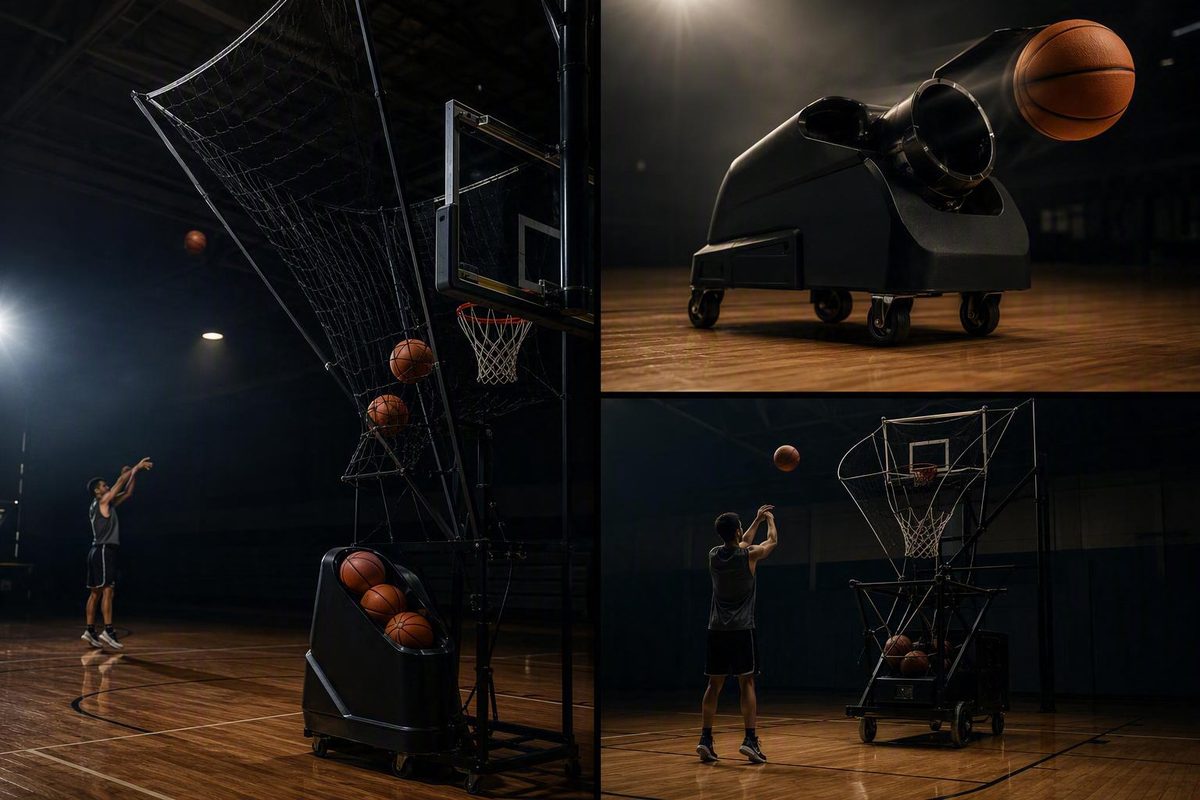
You need a basketball shooting machine only when ball retrieval is the thing limiting the workout: a solo player who loses most of each session chasing rebounds, no reliable passer, or a drill that needs repeatable passes at set spots and tempos. For close-range form work, a wall, a partner, or a passive net-and-ramp trainer does the job. If you do buy, choose the least complicated tier that supports the player’s next training task, not the one advertising the most shots per hour. Documented prices run from $499.99 for a non-powered trainer to $2,995 plus $424 to $474 delivery for a programmable home system; facility Gun models are quote-priced.
Pick the practice problem and who moves the machine; the tier and the matching documented products update below.
Which Shooting-Machine Tier Fits Your Practice Problem?
Passive or manually directed rebound trainer
Documented example: Dr. Dish iC3, $499.99, 35 lb (per GRIND’s comparison; confirm with Dr. Dish). A wall or a partner also covers this need.
Net-and-ramp return you point by hand. No powered passes, no make/miss count. Enough for close-range form shots and repeated shooting from one area.
| Product | Type | Listed price | Weight |
|---|---|---|---|
Dr. Dish iC3DetailsManually directed net-and-ramp trainer. Figures from GRIND’s comparison; confirm with Dr. Dish. Accessories, setup, durability: — | Passive trainer | $499.99 | 35 lb |
GRINDDetailsPowered return, nine pass positions chosen by hand, wall outlet, no make/miss recording. Folds to 38 × 13 × 18 in. Maker says vehicle loading may need two people. 1-year warranty, 30-day trial. | Portable powered | $1,995 sale | 110 lb |
Dr. Dish HomeDetailsApp-run automatic passing across 180°, five distances, stats, saved drills. Curbside delivery $424–$474 extra. Stored 40 × 30 × 78 in; 120 V; Wi-Fi for full features; not weatherproof. Multiplayer limit conflicts (3 vs 5) in Dr. Dish materials. 2-year warranty, 30-day guarantee. | Programmable home | From $2,995 | 275 lb |
Shoot-A-Way Gun 12K / 10K / 8000Details12K/10K list programming and analytics; 8000 emphasizes rebounding and selectable locations. 78 in high × 28 wide × 52 long. Not waterproof. Weight, power, and price: — (request a quote). 5-year parts / 1-year netting warranty. | Facility system | Quote only | — |
HOOPTEQDetailsSeller-advertised hoop-mounted, battery-powered return. Pre-order only, shipping planned for 2027. Final specs, controls, durability: — | Pre-order | $799 pre-order | — |
Source: manufacturer and seller pages (Dr. Dish, GRIND, Shoot-A-Way, HOOPTEQ) as cited in the article; not independent tests. Prices and specs change; — means not listed.
Match the Tier to the Problem That Interrupts the Workout
A powered shooting machine collects made and missed shots and returns passes to the player. Passing patterns, programming, statistics, and player profiles vary by model, so start from what actually stops the current workout.
| Training need | Lowest sufficient option | Main limitation |
|---|---|---|
| Close-range form work or repeated shots from one area | Wall, partner, or passive rebound trainer | Manual alignment; no passes around the court |
| Solo shooting from chosen spots, stored between sessions | Portable powered return machine | “Portable” can still mean heavy and outlet-dependent |
| Planned multi-location workouts for one player | Programmable powered system | Higher cost; software or connectivity requirements |
| Shared school, club, or team use | Facility-grade programmable system | Space, storage, training, maintenance, full ownership cost |
A partner remains more useful when a drill needs unpredictable passes, defensive pressure, verbal feedback, or immediate correction. This is a fit guide, not a best-machine ranking; the right tier depends on the player, the court, the storage route, and the budget.
Ball Return, Powered Passing, and Automatic Location Changes Are Different Products
Three functions get lumped together even though they create different workouts. Ball return means a net and ramp collect the shot and roll the ball in a selected direction. Powered passing means a mechanism sends the ball back with enough force for a catch-and-shoot repetition. Automatic multi-location passing means the machine rotates passes among programmed court positions without the player stopping to change each one.
A manually selected direction can support several shooting spots across a workout, but it cannot move the player through those spots inside one programmed sequence. Compare these controls before comparing headline speed:
- Pass-location selection: how many positions, and whether direction changes manually or automatically
- Passing distance: whether the pass reaches the spot without forcing an unnatural catch
- Time between passes: whether the slowest setting is comfortable for a developing shooter
- Shot-count targets: attempts, makes, time, or repetitions per location
- Workout programming: whether sequences can be created, saved, and repeated
- Result tracking: whether the machine independently counts attempts and makes
- Player profiles: how many users keep separate records, and whether limits are tied to a membership
Manufacturer materials show the spread. Dr. Dish Home lists five passing distances and automatic passing across a 180-degree range. Shoot-A-Way describes the Gun 12K with programmable locations and live heatmaps, while the 14X is advertised as adjusting passes for player height and location and delivering chest or bounce passes. The iC3 is a non-automatic net-and-ramp trainer, not a powered passer. GRIND’s nine pass positions are selected by hand, which is operationally different from an automatic multi-location program. These are manufacturer-described functions, not independently tested performance. Dr. Dish documents the Home controls on its store page, and Shoot-A-Way lists the Gun model features in its product catalog.
Counters and heatmaps show volume, makes, misses, and results by location. They cannot tell the player why a shot missed. A chart does not diagnose an unstable base, inconsistent foot placement, a sideways ball path, poor balance, or a rushed release.
For a developing shooter, the slowest controllable pass setting and the usable court locations matter more than maximum throughput. If the next ball arrives before the player can land, organize the feet, and hold the follow-through, the machine is dictating the drill instead of supporting it.
What Each Documented Model Actually Lists
The figures below come from manufacturer or seller pages, not independent testing. Prices, configurations, availability, and software terms change.
Dr. Dish iC3 (non-automatic trainer). Net-and-ramp return, manually directed. A GRIND-published comparison of shooting-machine categories reports $499.99 and 35 lb; because GRIND sells one of the compared products, use that page only for attributed figures, not its rankings, and confirm with Dr. Dish. Included accessories, setup requirements, and long-term durability are not documented.
GRIND (powered return machine). Powered return, manual selection among nine pass positions, wall outlet, no make-or-miss recording. GRIND’s comparison reports a $1,995 sale price; its own product page confirms 110 lb and folded dimensions of 38 by 13 by 18 inches. Deployed footprint, pass accuracy, noise, reliability, and consistent setup time are unknown.
Dr. Dish Home (programmable home system). App operation; configurable locations, ball count, tempo, goals, statistics, and automatic multi-location passing. Starts at $2,995. The manufacturer lists 275 lb and a 40-by-30-by-78-inch storage footprint. Current Dr. Dish materials conflict on multiplayer capacity: one lists three simultaneous players, another describes support for five users. Confirm the exact profile and multiplayer rules, the full membership feature split, included accessories, and offline functions before purchase.
The Gun 12K, 10K, and 8000 (facility systems). The 12K and 10K materials emphasize programming and analytics; the 8000 materials emphasize automatic rebounding and selectable pass locations. Do not transfer a tracking feature from one Gun model to another without confirmation. The company’s school sales page lists all three models at 78 inches high, 28 inches wide, and 52 inches long and uses request-based pricing, but it does not give model-specific weight or electrical details.
HOOPTEQ (advertised future product). The seller describes a battery-powered, hoop-mounted return system. The pre-order page lists a $799 price and shipping planned for 2027. Final specifications, delivery, compatibility, durability, weather limits, pass controls, and production performance are unestablished, so it is a pre-order, not a recommendation.
For every machine, treat setup time, noise, pass consistency, long-term reliability, offline operation, included accessories, and full ownership cost as unknown until the seller answers for the exact model.
Measure the Route From Storage to the Shooting Spot
A machine does not fit because its base fits under the basket. Measure the operating area, the vertical clearance, the approach to the hoop, and the whole transport route. Before ordering, write down the deployed floor area, the stored footprint, the maximum net height, overhead clearance, the narrowest doorway or gate, the court width available for passing, the required passing distance, the distance to an outlet, surface slope, any steps, curbs, grass, gravel, or thresholds, the tightest turn on the storage route, the protected storage spot, and the vehicle loading height if the machine travels.
Storage dimensions are not operating dimensions. A folded machine may pass through a doorway yet still be hard to turn in a hall, roll over a threshold, cross grass, or lift into a vehicle.
Dr. Dish lists Home with a 40-by-30-by-78-inch storage footprint, 275-pound weight, locking wheels, and adjustable net settings from 11 feet 6 inches to 12 feet 0.5 inches. It requires standard 120-volt power; an external battery is sold separately. Full functionality, including saved statistics, the training library, and updates, requires Wi-Fi, according to the Dr. Dish Home specifications.
GRIND shows why compact storage does not mean easy handling. The manufacturer lists 38 by 13 by 18 inches folded and 110 pounds, and says loading the machine into a truck or trunk may require two people. It runs from a standard outlet rather than an included battery, according to the GRIND product page.
“Outdoor use” does not mean weatherproof. Dr. Dish says Home can be used outdoors but is not weatherproof and must be protected from wet conditions. Shoot-A-Way says The Gun is not waterproof and must be stored away from the elements. Plan dry storage before buying. Use the exact model manual for assembly, electrical requirements, operation, maintenance, and safety; sales-page summaries are not substitutes.
Total Ownership Cost Runs Well Past the Sticker
Build an all-in estimate before comparing products:
| Cost item | Your amount |
|---|---|
| Machine price or written quote | $___ |
| Delivery or freight | $___ |
| Taxes | $___ |
| Required phone or tablet | $___ |
| Membership or software | $___ per month/year |
| Battery, cart, or transport equipment | $___ |
| Extension cord or approved power solution | $___ |
| Protected storage | $___ |
| Setup or installation | $___ |
| Maintenance and replacement parts | $___ |
| Financing cost over the full term | $___ |
| Estimated total ownership cost | $___ |
A starting price is not a delivered price. Dr. Dish Home is listed from $2,995, while standard curbside delivery is listed separately at $424 to $474, with possible additional charges outside the continental United States. The machine can operate without a membership, but the seller says membership unlocks functions including custom drill creation. Confirm the current subscription price and get a written list of what works without membership; these terms appear on the Dr. Dish Home store listing cited above.
Institutional Gun models use request-based pricing, so a complete current comparison is impossible without itemized quotes. Ask each seller to price comparable configurations, delivery, accessories, software, setup, and support.
Dr. Dish advertises a two-year warranty and a 30-day guarantee for Home. GRIND advertises a one-year standard warranty, optional extensions, and a 30-day trial. Shoot-A-Way advertises a five-year parts warranty and a one-year netting warranty for new and reconditioned Gun machines. Those headline periods do not reveal exclusions, return-freight responsibility, wear-item coverage, or conditions that void protection. Get the complete written policy before paying.
For a used or remanufactured machine, require the exact model and serial number, the current manual, software and app compatibility, the inspection and rebuild scope, replacement-part availability, the condition of battery, motor, sensors, and net, transferable warranty terms, and a demonstration of every pass and tracking function. Dr. Dish provides manuals for current and retired machines through its product-manual directory. The Shoot-A-Way help center lists model-specific manuals and setup resources for the 14X, 12K, 10K, Home Edition, 8000, and 6000.
Shots Per Hour Is a Claim, Not a Practice Metric
Throughput figures are manufacturer claims under unspecified conditions. Shoot-A-Way advertises up to 1,800 shots per hour for the Gun 10K and 12K. GRIND gives an expected range of roughly 500 to 1,000 shots per hour depending on pace and number of balls. Dr. Dish also advertises high-volume output. None of these are standardized independent tests, and real output depends on balls in circulation, time between passes, player movement, shot distance, drill design, rest, repositioning or programming time, and the quality of each catch and release.
Keep four practice metrics separate:
- Attempts delivered: balls the machine sends.
- Technically acceptable repetitions: shots completed with the intended balance, footwork, ball path, and release.
- Makes: shots that go in.
- Game-like decisions: Repetitions that require reading a cue, choosing an action, or responding to pressure.
Manufacturer pages support a narrow conclusion: machines reduce time spent retrieving rebounds and provide structured, repeated passes. They do not establish that a machine by itself improves shooting percentage, mechanics, confidence, or game performance.
Run the Machine Through Four Checkpoints
Do not begin with the machine’s fastest drill. Build from a repetition the player can control.
Stage 1: Close-Range Stationary Form Shots
Work close to the basket without rapid feeds. Use a pace that lets the player establish a stable base, repeatable foot placement, an unbroken ball path, an aligned shooting hand, visible backspin, and a follow-through held through the result. These are Basketball How’s instructional checkpoints, not validated universal standards. The recommended order is stance first, followed by ball path, hand placement, release, and follow-through.
Stage 2: Controlled Stationary Catches
Add machine-fed passes from one position. The player should catch and rise without shuffling, resetting the feet, leaning to chase the pass, or rushing the release. Set the interval slowly enough to finish each repetition before the next arrives. If the machine cannot pass slowly enough, use fewer balls, pause the sequence, or go back to a partner or manual rebounder.
Stage 3: Defined Footwork Into the Catch
Choose one footwork pattern, such as a hop or a one-two entry, and repeat it from one location with the same balance and release as Stage 2. Change one variable at a time: add movement without adding range, add range without increasing tempo, increase tempo without changing the footwork, and change location only after the previous version is repeatable.
Stage 4: Multi-Location or Game-Speed Sequences
Add automatic location changes, faster feeds, or decision prompts only after the earlier checkpoints hold. A multi-location drill should test movement and organization, not force the player to improvise mechanics to keep pace. With a passive trainer, redirect the return by hand after each block. With a manually directed powered machine, pick one position, complete the block, then change direction. With a programmable system, build a gradual sequence across locations starting with generous intervals.
Slow the interval, reduce the range, or end the block when balance deteriorates, foot placement drifts, the player reaches or leans for passes, the ball path develops a hitch, the release rushes, or the follow-through cannot be held. Shot data cannot replace a coach who sees the whole repetition; video helps a solo player review patterns but still needs interpretation.
Questions to Send the Seller Before Ordering
Require answers for the exact model and configuration:
- [ ] Exact deployed and stored dimensions, assembled weight, and full net-height range
- [ ] Doorway and turning clearance, minimum operating area, surface and slope limits
- [ ] Outlet, voltage, extension cord, or battery required
- [ ] Compatible phones, tablets, and operating systems
- [ ] Whether pass direction changes automatically or manually
- [ ] Whether the machine independently counts both makes and misses
- [ ] Slowest and fastest pass intervals and available passing distances
- [ ] How many balls can be used, and whether balls are included
- [ ] Which functions work without internet access and without a paid membership
- [ ] Whether one person can move and set up the machine under the manufacturer’s instructions
- [ ] Which accessories are required rather than optional
- [ ] An itemized quote covering delivery, taxes, setup, accessories, subscriptions, financing cost, and replacement parts
- [ ] Permitted outdoor use and required storage, in writing
- [ ] Warranty exclusions, claim procedures, and who pays return freight
- [ ] Return, cancellation, and trial terms, plus the software-update policy
- [ ] The current manual before ordering, and for a pre-order, which specifications and dates are estimates
Choose the least complicated tool that solves the current practice problem. Measure the court and the storage route, verify power and software requirements, and total the ownership cost. Then start with slow, close-range repetitions and advance only while balance, footwork, ball path, release, and follow-through hold. More returned balls help only when the repetitions stay purposeful.