
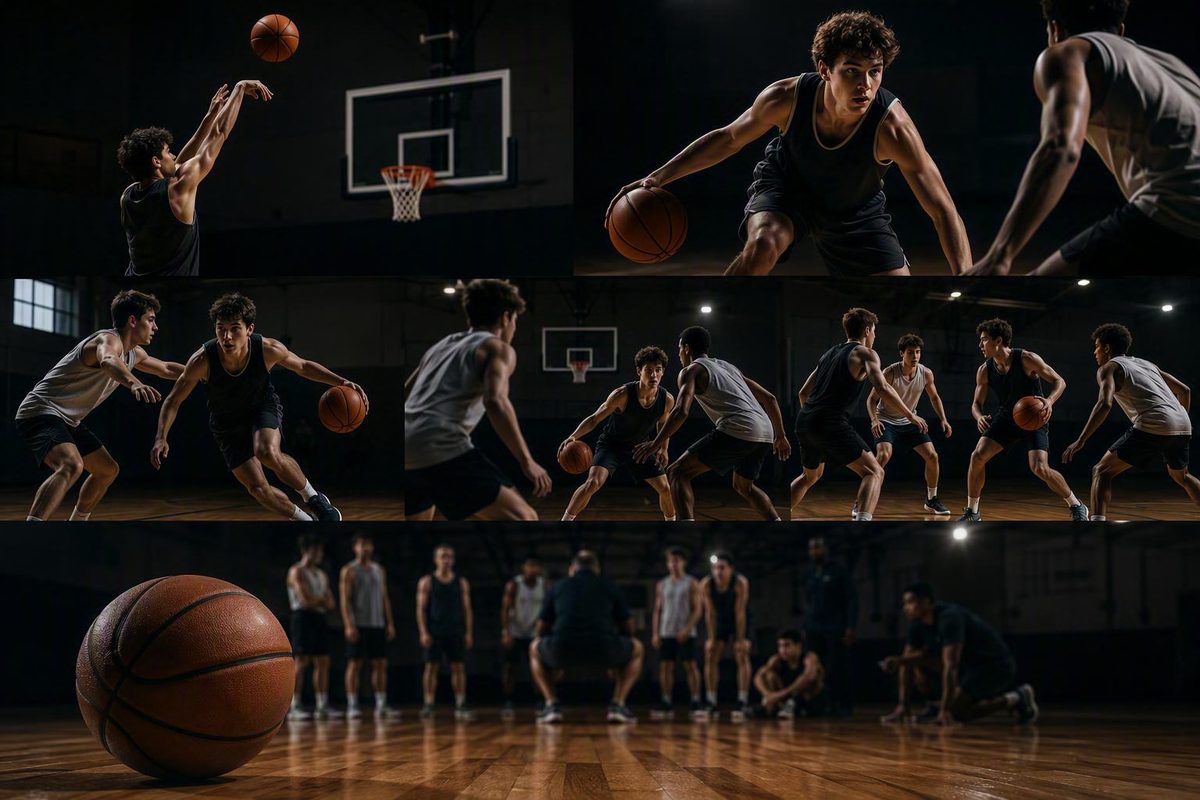
Build better decisions before the buzzer.
The best shot clock drills for high school basketball do more than force faster shots. They teach players to recognize an advantage, preserve spacing, execute the next action, and create an organized attempt before time expires.
A practical progression starts with timed shooting, then adds live 1-on-1, three forms of 2-on-2, 3-on-3 with team actions, and rule-accurate situational possessions. The clock creates the constraint; decision quality remains the objective.
Seven shot-clock drills at a glance
The first drill is a shooting primer. It creates urgency but does not include a defender, possession rules, or tactical choices. The other six are possession-based games in which players must decide whether to shoot, drive, pass, screen, relocate, or rebound.
| Drill | Objective and players | Starting clock and trigger | Next progression |
|---|---|---|---|
| One-Minute Shooting Primer | Establish rhythm and timer awareness; 1 shooter and 1 rebounder if available | 60 seconds; coach’s signal or first catch | Catch on the move, relocate, or use one dribble |
| 3–4-Second 1-on-1 | Recognize and attack an immediate advantage; 2 players | 3–4 seconds; defender hands the ball to offense | Change the start, narrow the court, or add a pass-and-relocate option |
| 7–8-Second Stationary 2-on-2 | Train spacing, first-defender reads, and help responses; 4 players | 7–8 seconds; defense hands over the ball | Require one pass, handoff, or ball screen |
| 7–8-Second Get-Open 2-on-2 | Create separation, catch ready, and attack recovery; 4 players plus coach | 7–8 seconds; coach’s pass is caught | Coach penetrates first to force help and recovery |
| 7–10-Second Transition 2-on-2 | Identify roles, communicate, and attack before the floor is organized; 4 players plus coach | 7–10 seconds; coach passes to establish offense | Increase transition distance or restrict space |
| 14-Second 3-on-3 | Add communication, relocation, and coordinated actions; 6 players | 14 seconds; offense receives the ball | Require two passes, then a ball screen |
| 35-Second Situational Possessions | Connect small-sided decisions to game states and local rules; 6 or 10 players | Full or partial possession; one defined legal trigger | Add deflection, rebound, inbound, and late-clock situations |
The 3–4-second, 7–8-second, and 8–14-second ranges are adjustable recommendations from the Game Plan Basketball shot-clock drill guide.
Lengthen the clock when players begin farther from the basket, must get open before receiving the ball, or have to execute several actions. Shorten it only after they can create an acceptable attempt without a noticeable increase in careless turnovers.
Before running the live drills, define an acceptable attempt from your team’s shot profile. It could be an uncontested finish, a balanced catch-and-shoot opportunity for an appropriate shooter, or another shot your offense is designed to create. It should not mean any ball released before the horn.
Set the rules before starting the timer
A 35-second clock is not a nationwide high school mandate. NFHS guidance permits each state association to adopt one, so game simulations must follow the current publication for the team’s state, league, season, and competition level.
Under the NFHS shot-clock guidelines, a last-second try must leave the shooter’s hand before the horn and then enter the basket or contact the ring or flange. A defensive touch does not create a new shot-clock period when the offense retains control. An unsuccessful try that misses the ring and flange does not satisfy the shot-clock requirement, and the horn alone does not stop play; an official must recognize the violation.
Rule check: Confirm the current state-association or league publication before programming starts, continuations, or resets. State associations may authorize partial resets, and rules may differ by competition level.
| Game event | Practice-clock treatment | Coaching application |
|---|---|---|
| Legal touch or catch on a throw-in | Start the clock | Use the same trigger on every inbound repetition |
| Change of team control | Start a new period as applicable | Operator calls “change” and resets |
| Defensive deflection, offense retains control | Continue the existing count | Run no-reset scramble possessions |
| Try contacts the ring or flange | End the existing period; set the next clock according to rebound control and local reset rules | Train the rebound and reset together |
| Air ball misses the ring and flange | Do not award an automatic reset | Continue according to team control and local rules |
| Locally authorized partial reset | Set only the prescribed time | State the reset aloud before the repetition |
Jurisdictions can differ substantially. The Illinois High School Association’s implementation notice requires a 35-second clock for varsity boys and girls beginning in 2026–27, while its use at junior varsity, sophomore, and freshman levels remains optional.
The Alabama High School Athletic Association’s announcement requires a 35-second clock for all classifications beginning in 2026–27 and specifies a 25-second reset after an offensive rebound. Neither state’s rule should be applied outside that association.
Drill 1: One-Minute Shooting Primer
Objective: Establish shooting rhythm and awareness of a running timer before adding defenders and possession decisions.
Setup: Use one shooter, one rebounder when available, one ball, one basket, and a one-minute timer. Select close-range, midrange, or three-point locations that fit the player’s age, strength, mechanics, and role. NBA range is not a necessary default.
Run the challenge toward 10 makes in one minute. Alternative levels are 20 makes in two minutes or 30 in three minutes, as described in PGC Basketball’s One-Minute shooting drill.
Track both makes and attempts by location. During the final five seconds, provide an audible countdown. The player should organize the feet, move the ball through the normal shooting path, and release without abandoning established mechanics merely to beat zero.
Progression:
- Shoot from a stationary catch.
- Catch on the move.
- Relocate after passing to the rebounder.
- Add a one-dribble pull-up.
- Move into live 1-on-1.
This is timed shooting, not a complete shot-clock possession drill. It creates pressure and clock awareness, but it does not include a defender, a change of possession, or tactical reads.
Drill 2: 3–4-Second 1-on-1
Objective: Train a rapid shoot, drive, or counter decision against a live defender.
Setup: Place two players at a wing, the top, a corner, high post, low post, or with the attacker’s back to the basket. Use one ball and one basket. Optional cones can define the available attack area.
Following the Game Plan Basketball drill, the defender hands the ball to the offensive player and triggers a 3–4-second clock. The attacker should scan before the handoff, read the defender’s feet, identify open space, and attack without wasting a dribble.
The guide awards the offense one point for a basket, foul, or offensive rebound. After an offensive rebound, require an immediate scoring attempt. As an editorial scoring option, award the defense one point for a stop, turnover, or clock violation.
Switch offense and defense after every possession. Once both players have attacked, rotate to a new starting location. Changing the angle prevents one preferred move from becoming the answer to every repetition.
Use four concise cues:
- Read the defender’s feet.
- See the available space before dribbling.
- Attack decisively.
- Remove dribbles that do not improve the angle.
Do not advance merely because players release the ball before the horn. The checkpoint is a controlled attempt created from a recognizable advantage, not an off-balance bailout.
To progress, narrow the court, change the starting position, or make a coach available as a pass-and-relocate option. Compress the clock only after players can execute those versions with control.
Drills 3–5: Three 2-on-2 games for half-court and transition decisions
Two-on-two gives the ball handler a live defender and introduces one help defender while keeping spacing mistakes easy to identify. Use the same trigger and scoring language for an entire block so players can concentrate on reads instead of changing procedures.
The 7–8-second half-court clocks and 7–10-second transition range below come from the Game Plan Basketball coaching guide. Treat them as starting points that can be adjusted for distance, skill, and required actions.
Stationary 2-on-2
- Objective: Read the first defender, maintain spacing, and respond immediately to help.
- Players: Two offensive players and two defenders.
- Court area: Half court, restricted with cones if needed.
- Equipment: One ball, one basket, timer, and optional cones.
- Alignment: Wing-corner, high-post-corner, high-post-wing, or corner-corner.
- Clock: Begin at 7–8 seconds.
- Trigger: The defense hands the ball to the offense.
- Scoring: As an editorial option, give the offense one point for an acceptable attempt before the horn and a bonus point for scoring. Give the defense one point for a turnover, violation, or forced low-quality attempt.
- Rotation: Switch offense and defense after each possession; change alignments after a short set.
- Cues: Read the first defender, attack available space, use efficient dribbles, hold useful off-ball spacing, and react immediately when help commits.
- Progression: Restrict space or require one pass, handoff, or ball screen.
Get-Open 2-on-2
- Objective: Create separation, catch in an attacking position, and punish a late recovery.
- Players: Two offensive players, two defenders, and a coach as passer.
- Court area: Half court.
- Equipment: One ball, one basket, and a timer.
- Alignment: Begin with the offensive players on opposite wings. As a coach-created adaptation, tell defenders to deny or trail according to the type of catch you want to train.
- Clock: Begin at 7–8 seconds.
- Trigger: Start on the catch after the coach passes to an open player.
- Scoring: Use the same optional process point and scoring bonus as the stationary version. The defense scores for preventing a catch until time expires, forcing a violation, or producing a poor attempt.
- Rotation: Switch offense and defense, then rotate which player initiates the attack.
- Cues: Change speed to get open, catch balanced, see the help defender, and keep the second offensive player spaced for a pass or cut.
- Progression: Have the coach penetrate first, forcing help and recovery before kicking the ball out for the live possession.
Transition 2-on-2
- Objective: Identify offense and defense immediately, communicate, and attack before matchups settle.
- Players: Four players and a coach.
- Court area: Half court to full court, depending on the start.
- Equipment: One ball, one basket, timer, and optional cones or colored markers.
- Alignment: Use a reaction start near midcourt or a cone start in which the coach’s pass identifies the offensive team.
- Clock: Begin with 7–10 seconds.
- Trigger: Start on the coach’s pass.
- Scoring: As an editorial option, the offense earns one point for an acceptable attempt before the horn and a bonus for a make. The defense earns a point for a turnover, violation, or forced low-quality attempt.
- Rotation: Change partners or roles after each short set.
- Cues: Identify roles immediately, communicate matchups, run to useful width, attack an unset defender, and avoid dribbling into both defenders.
- Progression: Increase the starting distance, restrict space, or require a pass before the shot.
Lengthen the transition clock when players begin farther from the basket. For all three games, add only one constraint at a time so you can identify whether the clock, available space, or required action caused the breakdown.
Drill 6: 14-Second 3-on-3
Objective: Develop quick advantage recognition, communication, spacing, passing, pivoting, and relocation without allowing one player to consume the possession through excessive dribbling.
Set up three offensive players and three defenders in the half court with one ball, one basket, and a visible or audible timer. The Game Plan Basketball drill guide recommends beginning with a stationary 14-second possession, with the clock starting when the offense receives the ball.
In the base version, permit an immediate attack. This reveals whether players can recognize an advantage already present in the alignment.
Then progress in sequence:
- Require two passes before a shot.
- Once players preserve spacing through those passes, require a ball screen after the second pass.
- As an alternative, use 3-on-3 track passing that flows into half-court play with an adjustable 8–14-second clock.
Score the offense for reaching the team’s defined acceptable attempt before the horn. As a coach-created scoring adaptation, award the defense for a turnover, violation, or disruption of the required action.
Rotate teams after a set number of possessions so every group plays both offense and defense. Before reducing the clock, check that the group can preserve spacing, complete the required action, recognize the resulting advantage, and avoid a rise in careless turnovers.
Drill 7: 35-Second Situational Possessions
This final drill is a coach-created application of the timing rules and small-sided progression. It is not an NFHS-prescribed drill.
Use 5-on-5 when roster size and court access allow, or 3-on-3 when they do not. Begin with a full 35-second possession only if that duration matches the rules for your jurisdiction and competition level. NFHS guidance authorizes adopting state associations to use that period but does not impose it nationally.
Call or display 20, 10, and 5 seconds so players practice moving from normal offense into the team’s late-clock action. Define that transition before the drill: for example, the 10-second call might initiate a preferred screening action, while the 5-second call signals the final creation phase.
As an organizational suggestion, assign late-clock roles before the ball becomes live:
- Creator: Initiates the late-clock advantage.
- Screener: Creates separation or forces a coverage decision.
- Spacers: Maintain passing windows and punish help.
- Rebounder: Pursues the shot without congesting the creator’s lane.
- Floor-balance safety: Protects against transition after the attempt.
Run these variations:
No reset: Begin with eight seconds. Create or recognize a defensive deflection while the offense retains control, then continue the existing count.
Air ball: Play through an unsuccessful attempt that misses the ring and flange without awarding an automatic reset. Apply team-control and reset rules exactly as the local publication requires.
Offensive rebound: Use only the reset prescribed by the relevant state or league. Alabama’s 25-second offensive-rebound reset is an Alabama rule, not a general high school standard.
Inbound: Start when the throw-in is legally touched. Give the offense five or eight seconds to execute a primary action and reach a broken-play outlet if the first option fails.
A coach or designated practice official should whistle recognized violations. If every repetition ends automatically at the horn, players may learn the wrong game behavior.
Track the percentage of possessions producing an acceptable attempt before the horn, along with turnovers, clock violations, offensive rebounds, and scores. Review the decision and the resulting shot separately.
Progress the constraint, not the panic
Use this progression ladder:
- Unopposed timed shooting
- Live 1-on-1
- Stationary 2-on-2
- Get-open or transition 2-on-2
- 3-on-3 with required actions
- Situational 3-on-3 or 5-on-5 possessions
Adjust one variable at a time:
- Clock length
- Starting location
- Available space
- Required passes
- Ball-screen requirements
- Transition distance
- Defensive advantage
Changing several variables at once makes it difficult to determine why execution improved or failed. If you reduce the clock while narrowing the court and adding a required pass, you cannot tell which constraint created the turnover.
Begin with more time when players start farther from the basket, must work to get open, or need to complete several actions. Do not assign universal freshman, junior varsity, and varsity practice clocks. Choose the starting time from what the group can currently execute.
Before reducing time, look for five checkpoints:
- Spacing remains functional.
- Players identify an advantage.
- Dribbles advance the possession instead of consuming time.
- The offense creates an acceptable attempt.
- Turnovers remain controlled.
Separate the result from the decision. A missed open attempt can represent better execution than a made, heavily contested bailout. Record makes, acceptable attempts before the horn, turnovers, violations, paint touches, and offensive rebounds, but establish team-specific baselines rather than treating any percentage as universal.
Where lower-level shot clocks are optional, freshman or junior varsity coaches can still use these games as developmental constraints. That does not mean a varsity mandate automatically applies to those competitions.
A ready-to-run 60-minute practice sequence
The schedule below is a proposed Basketball How sequence synthesized from the drill progression and a broader basketball practice-planning framework. It is not an official or tested formula.
| Time | Practice block | Main emphasis |
|---|---|---|
| 8 minutes | Dynamic warm-up and close-range shooting | Movement preparation and normal mechanics |
| 7 minutes | One-Minute Shooting Primer | Timer awareness, score recording, final-five organization |
| 10 minutes | 3–4-Second 1-on-1 | Immediate advantage recognition from 2–3 locations |
| 12 minutes | Stationary or Get-Open 2-on-2 | Spacing, help reads, and efficient attack |
| 12 minutes | 14-Second 3-on-3 | Immediate attack, then a required action if execution permits |
| 8 minutes | Full-clock or late-clock situations | Verified local starts, continuations, and resets |
| 3 minutes | Record and review | Select one decision-making checkpoint for the next practice |
For teams without a practice display, use a phone timer, assistant-operated timer, whistle, or verbal final-five countdown. These are practice tools only; they do not satisfy official game-equipment requirements.
Whatever timing tool you choose, keep the trigger and reset calls consistent. Players should know whether the clock begins on the handoff, pass, catch, legal touch, or gain of control.
Finish by identifying one behavior to retain and one constraint to adjust at the next practice. Verify the applicable rules, choose a consistent clock trigger, and teach players to create an organized attempt rather than merely beat the horn.