
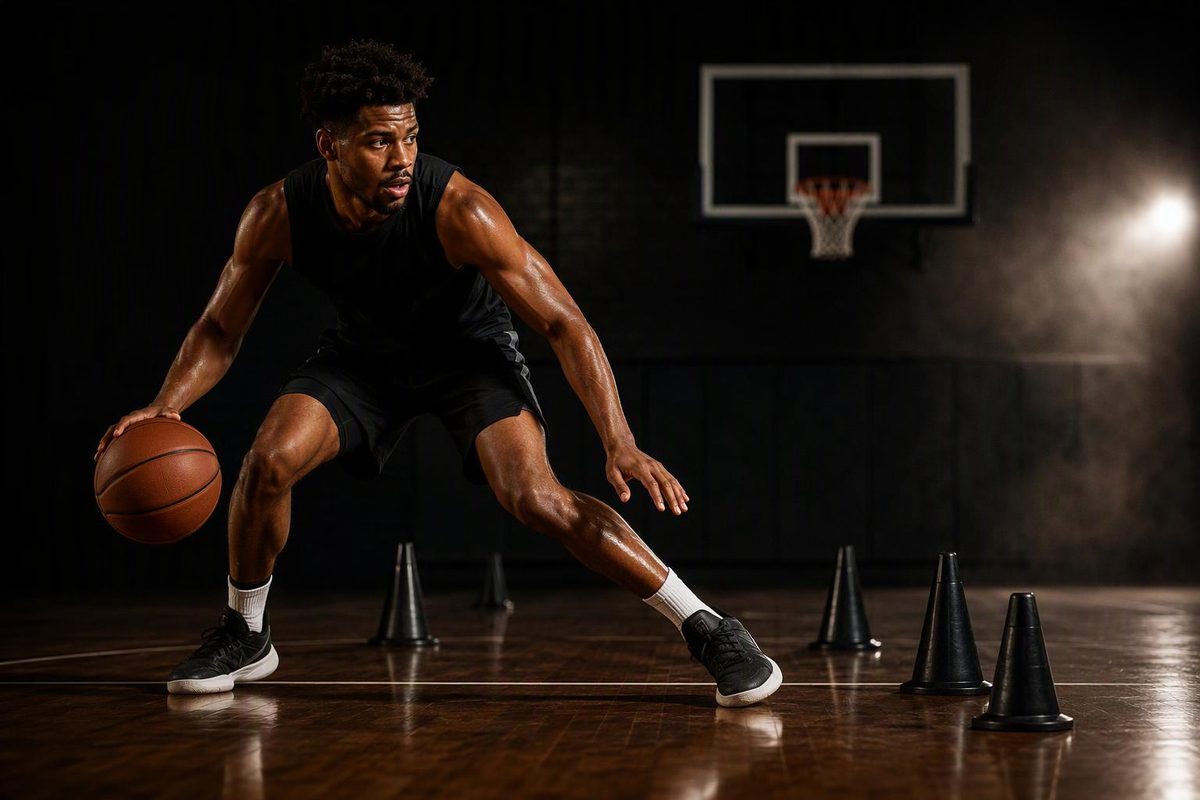
A crossover dribble switches the ball from one hand to the other with a bounce in front of your body. Use it to change direction—not just to change hands. The goal is to make a defender respond to one direction, then attack the other.
Start with a low, controlled exchange. Add footwork next, then speed. You need one basketball, a dry, flat surface and enough clear space to take several steps. A court line or chalk mark is useful; a hoop is optional.
1. Learn the low hand-to-hand exchange
Set your feet about shoulder-width apart, bend your knees and lower your hips. Keep your chest lifted enough to look ahead. This low stance and a ball kept close to the body are the starting cues in Watts Basketball’s stationary crossover drill.
For a right-to-left crossover:
- Take two controlled dribbles beside your right leg.
- Push the ball diagonally down and across your body. Aim for a floor spot between your feet and slightly in front of them.
- Have your left hand ready to meet the rebound near your left knee.
- Continue dribbling with your left hand. Do not catch the ball.
- Take two left-hand dribbles, then reverse the exchange.
For this beginner drill, aim to keep the crossover rebound around knee height or lower. Push firmly enough for the ball to reach the receiving hand without making you chase it.
Checkpoint: Complete 10 exchanges in a row without losing the ball, catching it or standing upright. Then repeat while looking at a fixed point ahead rather than down at the bounce.
Common miss: the ball hits your foot. Move the bounce target slightly forward. Keep it in front of your stance, not underneath your toes.
These repetition counts are practice targets, not a standardized skill test. If control breaks down, stay at this stage. For more basic handling work, use the solo dribbling progression.
2. Make your body change direction too
A quick hand exchange does little if your body stays in place. Now connect the bounce to a small direction change.
Start with an active right-hand dribble:
- Make a small step toward your right and let your shoulders suggest a right-side drive.
- Bend your right knee as that foot takes your weight. Keep the step short enough to remain balanced.
- Push the ball across to your left hand as you push off your right foot.
- Step diagonally forward-left with your left foot and continue with a left-hand dribble.
- Take another controlled step and dribble before resetting.
Reverse the instructions for left-to-right. Keep your hips low through the change instead of dipping and immediately popping upright. IMG Academy coach Vince Walden’s low-drop crossover instruction emphasizes dropping the hips and lowering the shoulders; here, use only as much lowering as you can control.
Checkpoint: Make five clean repetitions each way at walking pace. Each repetition should finish with you moving in the new direction, the ball beside your receiving hand and no stumble or extra recovery hop.
Common miss: you cross the ball but keep drifting the original way. Shorten the fake step. Practice pushing off that foot and taking one deliberate step in the new direction before adding more speed.
3. Add an approach and an exit
Place a chalk mark several walking steps ahead, leaving clear space beyond it. Treat it as a change-of-direction point, not as a defender you must dribble directly over.
- Approach slowly with your right hand.
- Begin the right-side fake just before the mark.
- Cross left, then take two quicker dribbles diagonally forward-left.
- Slow down under control and reset.
- Complete five repetitions, then switch sides.
Checkpoint before increasing speed: Finish five consecutive clean repetitions each way without looking down, striking your foot or taking a recovery dribble in place. Increase approach speed a little at a time—not the distance and speed together.
Common miss: you stop after the crossover. Count “cross, go, go,” with the final two counts marking your exit dribbles. Practice the move and its exit as one sequence.
Keep the dribble continuous—and test the timing
Guide the ball from its top or side rather than scooping underneath it. Specifically, NBA Rule 10, Section II prohibits putting a hand under the ball to carry it or bring it to a pause before continuing the dribble. Do not build a hesitation by holding the ball still. If you catch it and end the dribble, do not restart; see the double-dribble guide.
Solo practice lets you check control and footwork, but a mark cannot test your timing against a defender. When a partner is available, start with light defensive pressure. Cross when the defender moves to cut off your first direction; if that lane stays open, keep driving instead of forcing the move.