
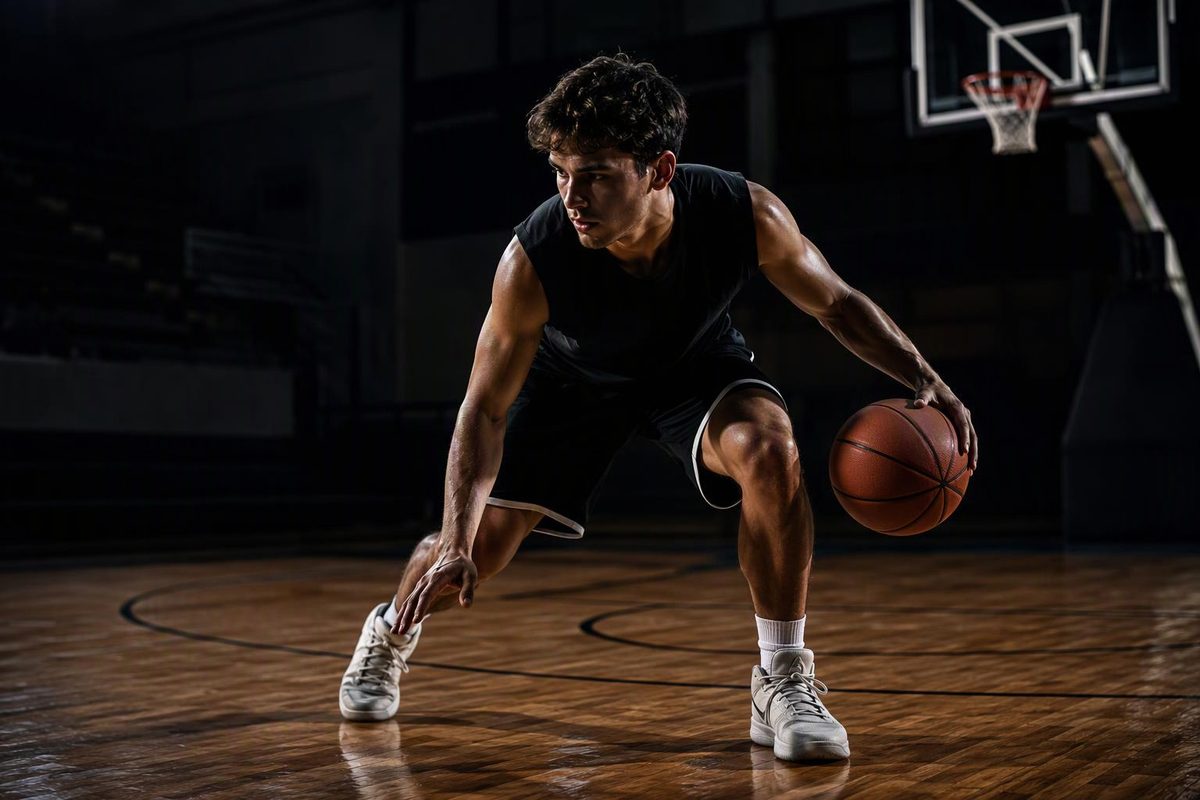
A double dribble happens when you end your dribble, then start dribbling again without a rules exception. Repeatedly bouncing the ball with both hands together is also illegal: touching it with both hands ends the dribble, so you cannot continue bouncing it.
The useful playing cue is: once you pick up your dribble, pass or shoot—do not bounce again. Both the NBA dribbling rule and FIBA Article 24 prohibit a second dribble after the first has ended, subject to specific exceptions.
What ends your dribble?
Two common ways your dribble ends are touching the ball with both hands simultaneously and letting it come to rest in one or both hands. You do not need to hold it for several seconds. A brief catch or controlled pause can end it. See the NBA definition of a dribble.
That makes these common situations easier to judge:
| Action | Legal or illegal? |
|---|---|
| Catch a pass with both hands, then begin your first dribble | Legal, provided your footwork is legal. Catching a pass is not a previous dribble. |
| Dribble right-handed, bounce a crossover, then continue left-handed | Legal if the ball keeps moving without being caught or carried. |
| Catch your dribble with both hands, then bounce again | Double dribble. |
| Stop moving your feet but keep dribbling | Not a double dribble. Stopping your feet does not end the dribble. |
| Pick up your dribble, make a shot fake, then dribble | Double dribble. A shot fake does not reset your dribble. |
A hesitation move is legal only if you maintain a legal dribble. Putting your hand underneath the ball and carrying it, or pausing it there and continuing, is an illegal carry. Traveling concerns illegal foot movement; double dribbling concerns restarting the dribble. These distinctions appear in NBA Rule 10.
Can you ever dribble again?
Yes. For example, if an opponent knocks the ball out of your control, you may recover it and dribble again. A pass or fumble touched by another player can also allow a new dribble. Both exceptions appear in NBA Rule 10, Section II and FIBA Article 24.2.
Simply dropping the ball after picking up your dribble does not give you a fresh dribble. Recovering a fumble and being allowed to restart are different questions.
Shot-related exceptions depend on the ruleset. The NBA requires your field-goal attempt to touch the backboard or rim before you can dribble again; FIBA lists a shot for a goal as an exception without that same contact requirement. Do not assume every airball recovery is legal in every league. Sources: NBA Rule 10, Section II and FIBA Article 24.2.
The penalty is a turnover, not free throws: the opponent receives a throw-in. The exact location follows the competition’s rules. The NBA specifies the nearest sideline spot, no nearer the baseline than the free-throw line extended; FIBA Article 22.2 specifies the nearest place to the violation, except directly behind the backboard.
Solo drill: bounce, pick up, pass
Practice the decision that prevents the violation before adding speed.
Setup: Use one ball, a clear patch of pavement and a solid wall suitable for passing. Stand close enough to make a comfortable chest pass.
- Stand with your feet planted and dribble five times with your right hand.
- Catch the ball with both hands. Say “done” to mark the end of the dribble.
- Without another bounce, chest-pass to the wall.
- Catch the returning ball and pause. That repetition is over.
- Reset for a separate repetition, then repeat with your left hand.
The wall is only a practice target, not another player. Passing to it does not legally restore your dribble in a game; each repetition here is a fresh practice start.
Checkpoint: Complete 10 clean sequences with each hand: five bounces, one pickup, one pass, and no extra bounce after the pickup. Then vary the number of bounces or increase their speed slightly.
Common miss: You catch the ball, hesitate, then bounce to get comfortable again. Correct it by passing immediately after the pickup at first. Add a brief pause only when you can consistently hold the ball without restarting.
Next, build continuous control with the solo dribbling progression, or practice legal stops and pivots with the footwork guide.