
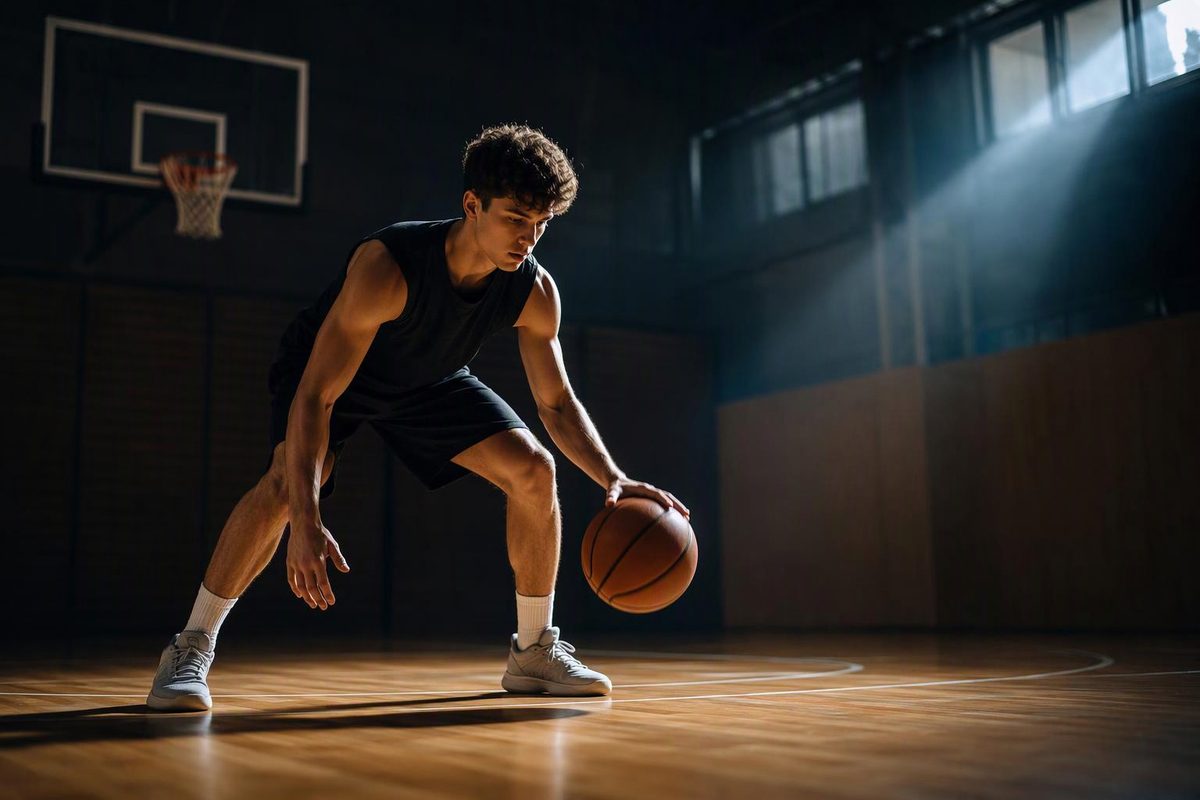
Start with a dribble you can control, then add movement, balanced stops, passing and close-range shots. These six drills for beginner basketball players require no partner.
You need: one basketball, a flat, dry surface and two chalk marks about 10 feet apart. Add a solid wall suitable for ball impacts and a hoop for the passing and shooting drills. Keep your path clear of traffic, windows and loose objects.
Work through the drills in order. The checkpoints below are practice targets for this routine—not official tests or promises of improvement. Meet the target before adding speed or distance.
1. Stationary dribble: control each hand
Setup: Stand with feet roughly shoulder-width apart and knees bent. Keep your chest up.
Action: Dribble beside your right hip for 20 seconds, keeping the bounce between knee and waist height. Repeat with your left hand. Complete three rounds, resting briefly between them. Push the ball down with your finger pads rather than slapping it, and gradually look ahead instead of watching every bounce.
Jr. NBA’s stationary dribble drill likewise emphasizes a bent-knee stance, eyes up and fingertip control with each hand.
Checkpoint: Complete 20 seconds with each hand without chasing the ball, while looking ahead for most of the set.
Common miss → correction: If the ball drifts away, slow down and aim each bounce at the same patch of ground beside your foot.
2. Walk-and-dribble: carry control forward
Setup: Use your two chalk marks as the start and finish.
Action: Walk from one mark to the other while dribbling with your right hand. Keep dribbling as you slow down and turn, then walk back using your left. Keep the ball slightly ahead and beside you so you do not kick it, and look toward your path. Complete four trips with each hand. If you lose control, stop and reset for a new repetition.
The progression is walking first, then jogging—not racing while learning. Jr. NBA’s walk-to-jog drill uses that sequence and stresses control with eyes up.
Checkpoint: Complete four trips with each hand without losing the ball or stopping to recover it.
Common miss → correction: If you run ahead of the bounce, shorten your steps and return to a slower walk. Add a light jog only after passing the checkpoint.
For more hand-change work, follow the solo dribbling progression.
3. Jump stop and pivot: finish balanced
Setup: Put the ball aside for the first part.
Action: Take two walking steps, make a small hop and land on both feet together. Bend your knees and hold still for three seconds. Repeat five times.
Next, pick up the ball while standing still. Keep your left foot in place and move your right foot through four small quarter-turns until you face forward again. Turn on the ball of the planted foot without moving it to a new spot. Reset, then repeat with your right foot staying in place. Do two rounds per foot.
These are separate exercises: learn the landing first, then the stationary pivot. Jr. NBA’s jump-stop work emphasizes holding a balanced landing; its basic pivot drill uses quarter-turns around a fixed foot.
Checkpoint: Hold five landings without an extra recovery step, then complete each pivot round without sliding the planted foot.
Common miss → correction: If you wobble, reduce the hop or turn size. Stay bent through the knees instead of standing taller during the turn.
Use the footwork progression before combining dribbling, stopping and pivots.
4. Wall chest pass: hit a target
Setup: Mark a chest-height target about a handspan wide on a suitable wall. Stand about 5 feet away; adjust if the rebound is difficult to manage.
Action: Hold the ball at chest level with both hands. Step toward the target, extend your arms and finish with your thumbs pointing down. Let the rebound bounce once before catching it and resetting. Make two sets of 10 passes.
This follows Jr. NBA’s stationary wall-passing instructions, including the step, arm extension and one-bounce catch.
Checkpoint: Hit the target on eight of 10 passes and catch the returns without scrambling.
Common miss → correction: If passes wander sideways, finish both hands toward the target rather than pushing harder with one hand. Move farther away only after your accuracy holds.
5. Close form shooting: repeat the release
Setup: Stand a few feet from the hoop, close enough to reach it without heaving.
Action: Place the ball in your shooting hand with your elbow underneath it. Bend your knees, then extend your legs and shooting arm together. Finish with your wrist relaxed forward and hold that position until the ball reaches the basket. Take two sets of 10 shots, retrieving each rebound.
Jr. NBA’s one-hand form-shooting drill starts within a few feet and uses those release cues. If holding the ball one-handed is difficult, lightly support its side with your other hand without pushing at release.
Checkpoint: Make seven of 10 while staying balanced and using the same release. Repeat the target in a second set before stepping back.
Common miss → correction: If you strain or fling the ball, move closer instead of adding force. Use the step-by-step shooting guide to check your hand placement.
6. Layup rehearsal: match hand and takeoff foot
Setup: Start without the ball, with room for two steps and a small jump.
Action: For a right-hand layup—a close shot usually taken off the backboard—step right, then left; jump from the left foot and reach up with your right hand. Reverse it for the left side: left, right, then jump and reach with your left hand. Perform five rehearsals per side. This matches Jr. NBA’s layup footwork teaching.
For this solo routine, simplify the finish before adding an approach: hold the ball while standing close to the basket on the right side with your left foot planted. Bend that knee, jump from that foot and finish with your right hand toward the backboard square. Release the ball before landing, then rebound and reset. Reverse the hand and takeoff foot on the left. Take 10 attempts per side.
Checkpoint: Complete five correct rehearsals and six controlled makes out of 10 on each side before adding an approach dribble.
Common miss → correction: If you jump from the wrong foot, put the ball down and repeat the slow rehearsal aloud: “right, left, up” or “left, right, up.”
Put it into a 25-minute practice
Warm up for three minutes with walking, easy jogging and gentle changes of direction. Then allot:
- Stationary dribble: 3 minutes
- Walk-and-dribble: 4 minutes
- Jump stop and pivot: 3 minutes
- Wall passing: 3 minutes
- Form shooting: 4 minutes
- Layup rehearsal and finishing: 5 minutes
Use any remaining time within a block to reset or repeat—not to rush. If the repetitions take longer, extend the session rather than hurry your shots or rebounds. Without a hoop or suitable wall, spend those blocks repeating dribbling and footwork. Record one result, such as left-hand trips completed or close shots made, so your next practice starts at the right level.