
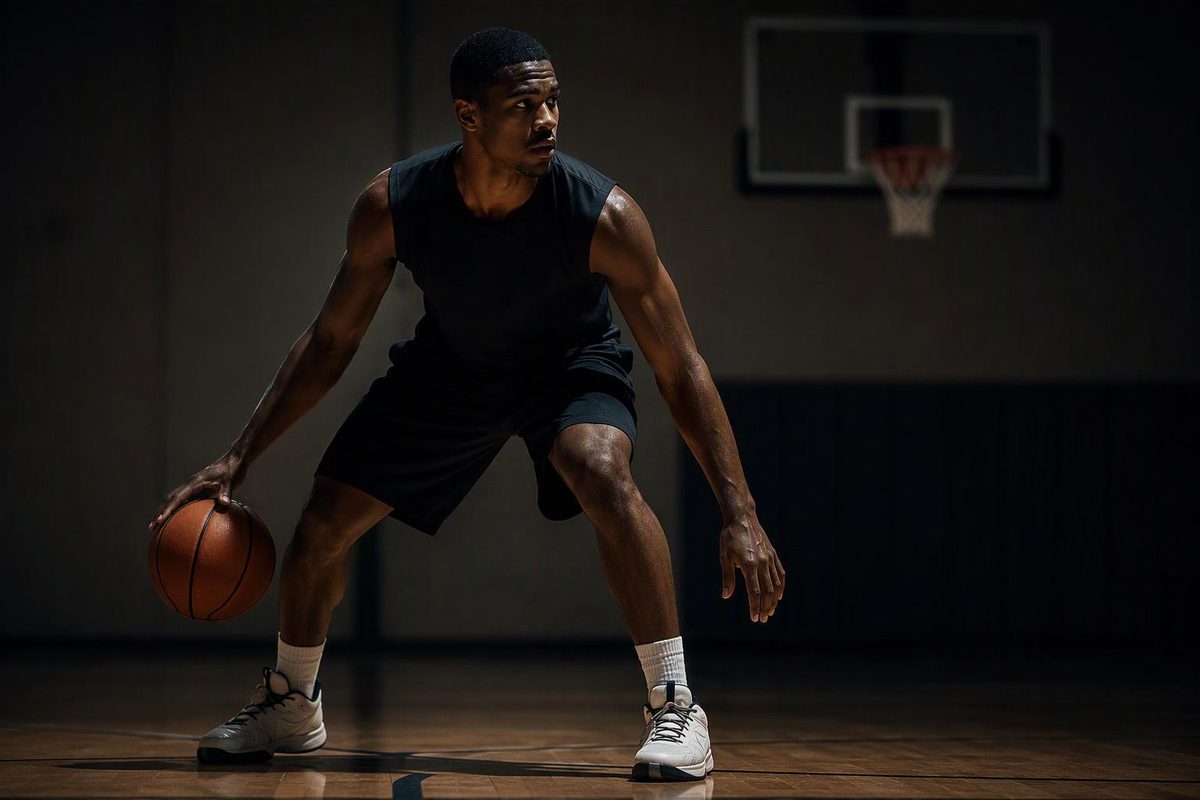
A point guard runs the team’s offense: brings the ball up the court, organizes teammates, reads the defense, and helps create good shots through passing or scoring. Jr. NBA identifies running the offense, dribbling, and passing as the role’s core responsibilities. The position is also called “the 1” on play diagrams. Basketball for Coaches
Playing point guard is not about dribbling the most. It is about moving the team into a useful attack while protecting the ball.
The point guard’s main jobs
1. Bring the ball up safely
Be available for an inbound or outlet pass—the pass that starts an attack after a rebound. Advance with your eyes up so you can see teammates and defenders.
Against pressure, use a pass when it is safer than dribbling. Do not try to split two defenders just because you are the designated ball-handler. Coach’s Clipboard recommends staying calm against a press, avoiding trapping corners, and passing rather than dribbling through a double-team.
2. Organize the offense and control the pace
Know the team’s plays and where each teammate should start. Use short, clear communication: call the play, point out an empty spot, or remind teammates about the clock.
Tempo means the pace of play. Push forward when your team has a clear advantage before the defense gets set. If that advantage disappears, organize the half-court offense rather than forcing a rushed attempt. The right pace depends on the coach’s plan, the players on the floor, and the game situation—not simply how fast you can dribble. Coach’s Clipboard
3. Create scoring opportunities
Look for an open teammate, an available driving lane, or a favorable matchup. A useful pass arrives where the receiver can catch it and act without recovering their balance.
For example, if you drive toward the basket and a second defender moves over to stop you, look for the teammate that defender left open. If nobody helps and you have a clear finish, take it.
Keep passes simple. A chest or bounce pass that reaches its target is more useful than a difficult pass chosen for appearance. Coach’s Clipboard
4. Be a scoring threat
A point guard does not have to be pass-first on every possession. Your scoring responsibility depends on your skills, your teammates, and the coach’s system.
Take an open shot within your practiced range or attack a clear lane. Passing up every scoring chance makes you easier to defend; forcing shots ignores the organizing part of your job. Coach’s Clipboard stresses both finding teammates and looking for your own shot.
5. Defend and communicate
The point guard commonly guards the opponent’s point guard, though assignments can change. Jr. NBA
Your first aim is to contain the dribble—not chase a steal that lets the opponent get past you. Call out screens, follow your team’s coverage, and know your transition assignment when a shot goes up. A screen is an opponent positioning themselves to obstruct your path; how you defend it should match your coach’s instructions. Coach’s Clipboard
Point guard versus shooting guard
The point guard usually takes more responsibility for initiating and organizing the offense. The shooting guard usually does more work getting available for perimeter shots. Both need handling, passing, shooting, and defensive skills; teams can share those responsibilities. Basketball for Coaches
Practice the foundation: eyes-up handling into a pass
Use this short solo progression to connect ball control with a balanced pass. You need one ball, clear space, and a safe wall with a chest-height target about a handspan wide. Leave enough room to stop comfortably before reaching the wall.
- Control first: Dribble in place for 20 seconds with each hand while looking at the target. Keep your knees bent and the ball beside your body. Before adding movement, complete the interval with each hand without losing control or looking down.
- Add movement: Start several steps from your passing spot. Walk toward it while dribbling, then stop under control and secure the ball. Reset and repeat with the other hand. Add the pass only when you can stop balanced without shuffling your feet.
- Add the pass: After stopping, send a two-hand chest pass at the target. Catch the rebound without lunging. Use the stop-and-pivot progression if your feet shuffle after you pick up the ball.
Checkpoint: Before increasing speed, complete eight of ten repetitions with each dribbling hand without losing the ball, looking down, shuffling after the stop, or missing the target. These are practice targets, not formal point-guard standards.
Common miss: You stare at the dribble and notice the target too late. Slow down and return to stationary handling until you can keep your eyes forward. Build from there with the solo dribbling progression.
Solo work builds the mechanics. To practice deciding when to pass or drive, add teammates and a defender in 2-on-1 or 2-on-2 play.